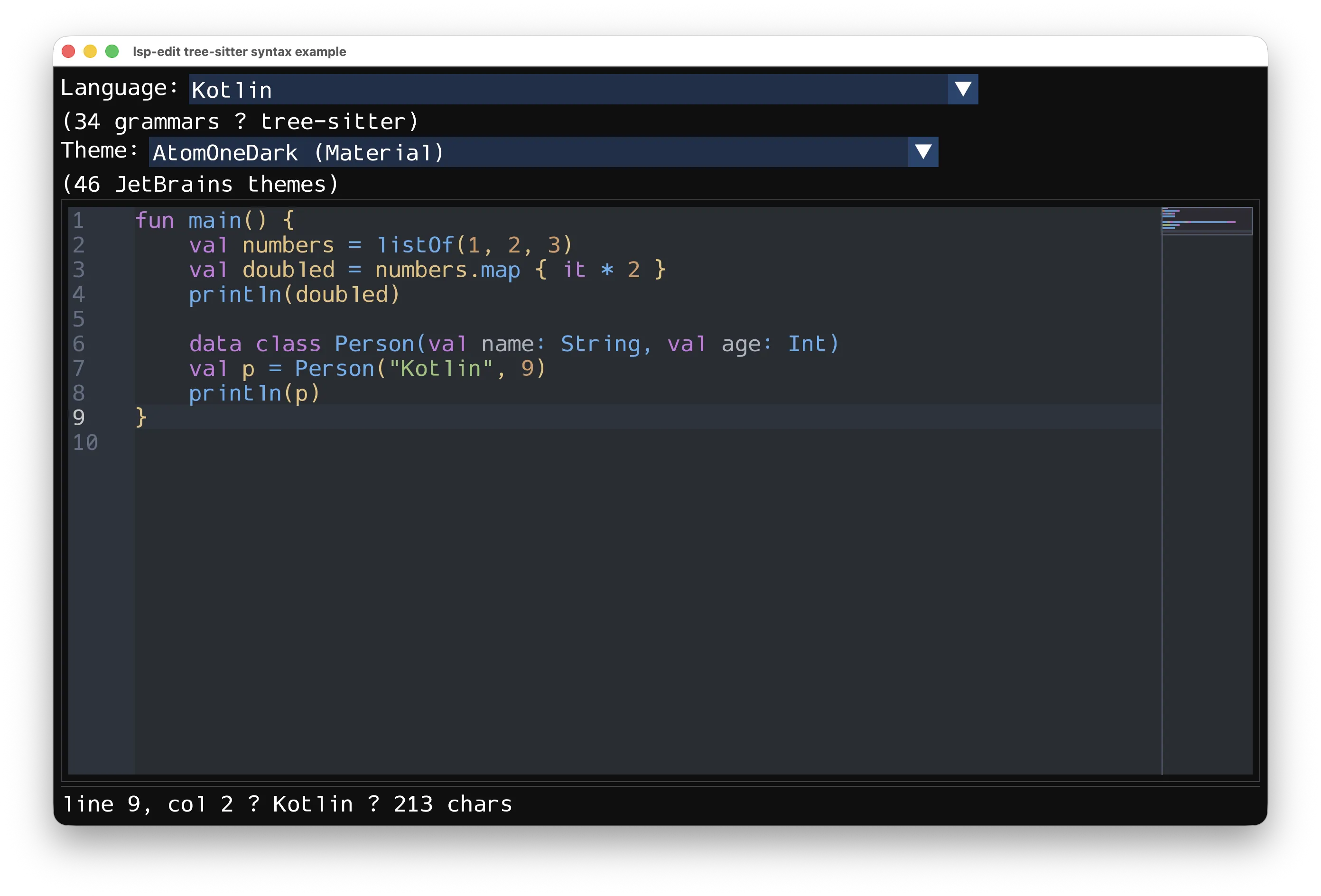
Language-server-driven code editor widget rendered with Dear ImGui, wiring full LSP and DAP: diagnostics, completion, hover, go-to-definition, semantic tokens, folding, inlay hints, breakpoints, diff view.
A language-server-driven code editor widget for Kotlin Multiplatform, rendered with Dear ImGui via imgui-kmp and wired to language servers through lsp-kmp.
The widget is a self-contained Editor that you render inside any ImGui
window; an optional LspEditor layer binds it to an LSP server
(didOpen/didChange, diagnostics, hover, completion, go-to-definition,
semantic tokens, folding, inlay hints, code lenses, signature help, rename,
references). A DiffView renders side-by-side diffs, and
DapSession drives a debug adapter (lsp-kmp's DebugClientLauncher is the
protocol end): the handshake, every breakpoint kind, stepping (reverse too),
stack/scopes/variables with editing, exception details, the debug console.
Published on Maven Central, so mavenCentral() is the only repository you
need:
// build.gradle.kts
kotlin {
    sourceSets {
        commonMain.dependencies {
            implementation("cn.enaium.imgui:lsp-edit:1.0.4")
            // lsp-edit's signatures are written in these types, and the
            // published POM keeps them at runtime scope — declare them too,
            // or calls like editor.render("##e", ImVec2(-1f, -1f)) do not
            // compile.
            implementation("cn.enaium.imgui:imgui-kmp:1.93.0.1")   // ImVec2, ImGui, Icon…
            implementation("cn.enaium:lsp-kmp:1.0.1")            // LspClient, DapSession…
        }
    }
}
Through a version catalog:
# gradle/libs.versions.toml
[versions]
lsp-edit = "1.0.4"
imgui-kmp = "1.93.0.1"
lsp-kmp = "1.0.1"

[libraries]
lsp-edit = { module = "cn.enaium.imgui:lsp-edit", version.ref = "lsp-edit" }
imgui-kmp = { module = "cn.enaium.imgui:imgui-kmp", version.ref = "imgui-kmp" }
lsp-kmp = { module = "cn.enaium:lsp-kmp", version.ref = "lsp-kmp" }
The rest arrives with it (the published POM pins these; all are runtime scope, so they are on the classpath at run time):
| Dependency | Version | What it brings |
|---|---|---|
imgui-kmp |
1.93.0.1 | the ImGui bindings the widget renders through |
lsp-kmp |
1.0.1 | protocol models, transports, the DAP client |
ktreesitter |
0.25.1 | the tree-sitter core (grammars are yours to add) |
xicons-imgui-core / xicons-imgui-intellij
|
1.0.3 | the icon set (completion kinds, breakpoints) |
kotlinx-coroutines-core / kotlinx-serialization-json
|
1.11.0 |
The POM also excludes xicons-imgui-intellij-g, which its own metadata
references but which was never published — consumers do not have to repeat
that exclusion.
Targets: JVM, Android, macOS (x64, arm64), iOS (x64, arm64, simulator), tvOS (arm64, simulator), watchOS (arm64, simulator, device), Linux (x64, arm64) and Windows (mingwX64).
Two constraints worth knowing before you pick targets:
TreeSitterHighlighter and HighlightQueries exist only where ktreesitter
is published — JVM, Android, macOS, Linux, Windows and iOS
arm64/simulator. iosX64, tvOS and watchOS get the rest of the library
without them.compileSdk = 37: imgui-kmp's AAR is compiled
against API 37.onContextMenu hook so hosts append LSP actions
(Go to Definition, Find References, Rename…).palette, 25 PaletteIndex slots), including
the 46 JetBrains IntelliJ palettes in JetBrainsThemes.setBreakpointMarkers / EditorBreakpoint; onBreakpointsChange tells
the host).EditorFontSettings + installEditorFonts): a main face, a
fallback TTF merged into it so glyphs the main font lacks (CJK, symbols)
render instead of tofu, and an optional smaller face for inlay hints and
inline code chips — all scaled by the framebuffer density. Call it before
the atlas is built, then hand EditorFonts.main to Editor.font and
EditorFonts.small to Editor.inlayHintFont / MarkdownCode.codeFont.Aa / ab / .* toggles, live match counter, Enter / Shift+Enter
navigation, per-match and replace-all (one undo step each), regex $n
expansion, Esc to close. The bar owns the keyboard while focused.EditorHighlight(line, start, end, fill, border) + Editor.highlights draws translucent fills with an optional
border under the glyphs — they scroll with the text, clip to the text area
(never the gutter or minimap) and are what the find bar uses.startRename / cancelRename / onRenameCommit): the
symbol becomes the selection and is edited directly, arrows/Home/End move
inside the name, every other occurrence follows live, Enter commits (the
host performs the LSP rename), Esc restores everything.onTextChange), cursor moves, hover, token
providers, code-lens clicks and breakpoints so hosts can plug in LSP data.
Hosts that implement some features themselves can chain instead of being
replaced: onTextChange, onHover, onHoverEnd, onCodeLensClick and
keysReservedByOverlay all call the previous handler first.lastChangeWasHistory marks undo/redo notifications, so hosts can skip
typing-only reactions (a completion popup must not open mid-undo).queueTextInput / inputText for host text-input routing, plus
isFocusedStrict (keyboard focus only, excludes hover) for platform
IME management.lang blocks as read-only, syntax-highlighted code
(theme palette, no line numbers, no editing, no scrolling) — the
imgui-kmp Markdown extension has no code hook, so lsp-edit splits the
input at fences and draws the code blocks itself.`inline code` renders as small bordered chips with a smaller font.editor.palette.initialize / notifyInitialized / shutdown / exit,
document sync (didOpen / didChange / didClose), server notifications
(publishDiagnostics, showMessage, logMessage).workspace/applyEdit (handlers
stack via addApplyEditHandler, the first that returns true wins),
workspace/configuration (null per requested section) and
window/workDoneProgress/create. Without the configuration answer
IntelliJ-based servers refuse to serve features such as inlay hints.DocumentSymbolResult array serializer by
decoding the raw JSON element.didChange sync.publishDiagnostics → gutter markers.MarkdownCode): it stays
open while the pointer is on it and closes after a short grace period once
the pointer leaves both the code and the window.CompletionItemKind (CompletionIcons, from the
xicons-imgui-intellij set); kinds IntelliJ has no distinct icon for
render unadorned. Signature-help popup with the active parameter
highlighted.requestCodeActions() lists quick fixes and
refactors in a caret-anchored, borderless, resizable popup
(renderCodeActionPopup(), Up/Down + Enter, Esc or click-outside closes).
An action's edit is applied directly; a server command is handed to
onExecuteCommand, whose edits then arrive as workspace/applyEdit.features: Set<LspFeature> selects what an instance drives
(DIAGNOSTICS, COMPLETION, HOVER, CODE_ACTIONS, SEMANTIC_TOKENS,
INLAY_HINTS, CODE_LENS, DOCUMENT_SYNC). A host that still implements
some capabilities itself enables only the rest while it migrates — the
editor then leaves the client's notification slots and the editor's
tokenProvider untouched instead of replacing the host's.TreeSitterHighlighter + HighlightQueries (per-language queries from
zed) live in the treesitterMain source set (JVM, macOS, Linux, Windows,
iOS, Android); the 34 grammar bindings are supplied by the host via
tree-sitter-languages-kmp (see examples:syntax).| Module | Description |
|---|---|
lsp-edit |
The library: Editor, LspEditor, LspClient, MarkdownCode, JetBrainsThemes, TreeSitterHighlighter, DiffView, DapSession, transports. |
examples:common |
Shared example host (SdlRendererApp, sample servers). |
examples:editor |
ImGui window hosting LspEditor against an in-process demo server (code lens, indent-guide toggle, debug panel). |
examples:diff |
Side-by-side DiffView of two Kotlin samples. |
examples:kotlinlsp |
Real-LSP example: connects to kotlin-lsp over stdio. |
examples:syntax |
Tree-sitter syntax showcase: 34 grammars + JetBrains theme switcher. |
./gradlew build                       # compile all targets
./gradlew :lsp-edit:jvmTest           # run the JVM test suite
./gradlew :examples:syntax:jvmTest    # 34-language tree-sitter highlight tests
Targets are listed under Dependency.
JVM (macOS adds -XstartOnFirstThread automatically):
./gradlew :examples:editor:jvmRun
./gradlew :examples:diff:jvmRun
./gradlew :examples:syntax:jvmRun
Real Kotlin LSP (requires kotlin-lsp on PATH; --stdio is mandatory —
kotlin-language-server defaults to socket mode):
./gradlew :examples:kotlinlsp:jvmRun --args="--file /path/to/File.kt"Native targets read IMGUI_KMP_FRAMES=N (or --frames N on the JVM) to exit
after N frames for headless CI. The JVM mains of examples:editor and
examples:syntax also take --font <path> for the main editor font (the
built-in font when omitted); either way they merge a system CJK font found on
the host as the fallback. Every example with native targets (editor,
diff, syntax) links an executable per platform:
./gradlew :examples:syntax:linkDebugExecutableMacosArm64   # also linuxX64,
                                                           # linuxArm64, mingwX64
IMGUI_KMP_FRAMES=3 ./examples/syntax/build/bin/macosArm64/debugExecutable/syntax.kexe
examples:kotlinlsp is JVM-only by design: it launches the external
kotlin-lsp process and talks to it over its stdio streams.
// A plain editor widget inside any ImGui window.
val editor = Editor(initialText = code, language = Language.kotlin)
editor.render("##editor", ImVec2(-1f, -1f))

// Bind it to a language server over any MessageTransport.
val lspEditor = LspEditor(editor, client, uri = "file:///Test.kt", languageId = "kotlin")
lspEditor.start(processId = pid)          // initialize + didOpen
lspEditor.drain()                         // call every frame
lspEditor.editor.inputText(text)          // route host text input to the editor
Markdown with fenced code blocks (e.g. LSP hover content):
MarkdownCode.render(markdownConfig, hoverText, language = editor.language, palette = editor.palette)Switch editor themes:
editor.palette = JetBrainsThemes.all[index].secondTree-sitter highlighting (host supplies the grammar bindings):
val highlighter = TreeSitterHighlighter(spec.language(), spec.query)
highlighter.setText(code)
editor.tokenProvider = { line -> highlighter.spansForLine(line) }
See the examples/ modules for complete wiring, including how text input is
routed from the host event loop.
MIT — see LICENSE.