
Line-by-line transliteration of an upstream tracing↔OpenTelemetry integration, adding OpenTelemetry context to spans, injecting/extracting trace data, setting attributes/status, events, and optional metrics export.


This is a Kotlin Multiplatform line-by-line transliteration port of tokio-rs/tracing-opentelemetry.
Original Project: This port is based on tokio-rs/tracing-opentelemetry. All design credit and project intent belong to the upstream authors; this repository is a faithful port to Kotlin Multiplatform with no behavioural changes intended.
This is an in-progress port. The goal is feature parity with the upstream Rust crate while providing a native Kotlin Multiplatform API. Every Kotlin file carries a // port-lint: source <path> header naming its upstream Rust counterpart so the AST-distance tool can track provenance.
The text below is reproduced and lightly edited from
https://github.com/tokio-rs/tracing-opentelemetry. It is the upstream project's own description and remains under the upstream authors' authorship; links have been rewritten to absolute upstream URLs so they continue to resolve from this repository.
Utilities for adding OpenTelemetry interoperability to tracing.




tracing is a framework for instrumenting Rust programs to collect
structured, event-based diagnostic information. This crate provides a
subscriber that connects spans from multiple systems into a trace and
emits them to OpenTelemetry-compatible distributed tracing systems
for processing and visualization.
The crate provides the following types:
OpenTelemetryLayer adds OpenTelemetry context to all tracing spans.OpenTelemetrySpanExt allows OpenTelemetry parent trace information to be
injected and extracted from a tracing span. It also provides methods
to directly set span attributes (set_attribute), span status (set_status),
and add OpenTelemetry events with dynamic attributes using the current time
(add_event) or a specific timestamp (add_event_with_timestamp).Note that version numbers for this crate are not synchronized with the various OpenTelemetry crates, despite having similar version numbers. For discussion, see issue #170.
As of 0.26, tracing-opentelemetry is one version ahead of the opentelemetry crates, such that tracing-opentelemetry 0.26.0 is compatible with opentelemetry 0.25.0, but due to semver compatibility concerns, this may not always be the case.
# Run a supported collector like jaeger in the background
$ docker run -d -p4317:4317 -p16686:16686 jaegertracing/all-in-one:latest

# Run example to produce spans (from parent examples directory)
$ cargo run --example opentelemetry-otlp

# View spans (see the image below)
$ firefox http://localhost:16686/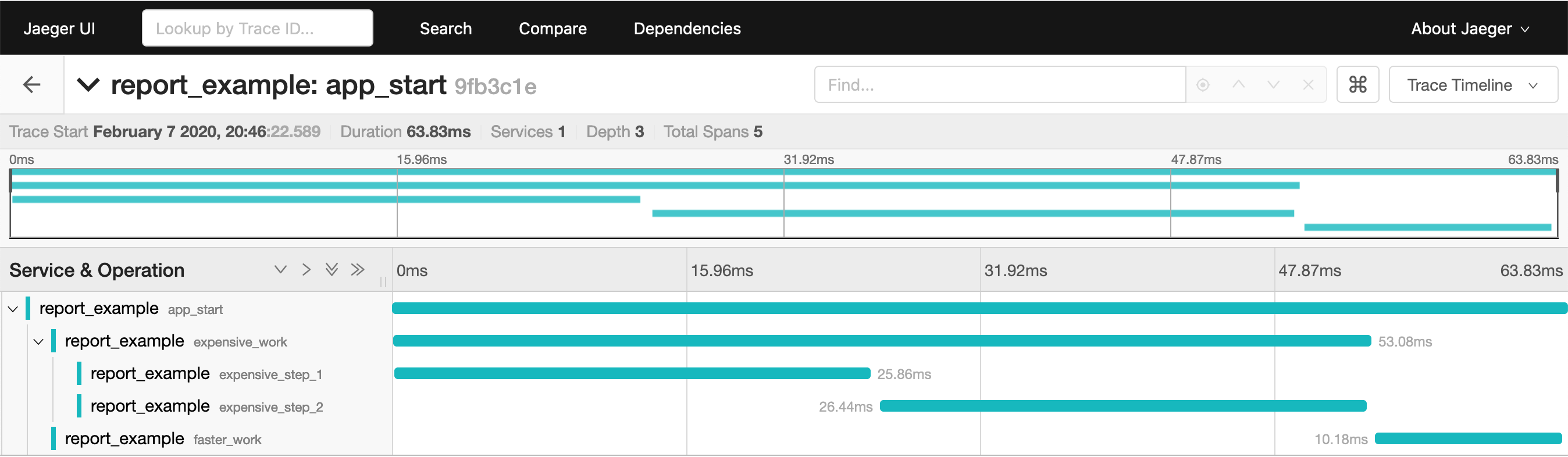
metrics: Enables the MetricsLayer type, a layer that
exports OpenTelemetry metrics from specifically-named events. This enables
the metrics feature flag on the opentelemetry crate.This project is licensed under the MIT license.
Unless you explicitly state otherwise, any contribution intentionally submitted for inclusion in Tracing by you, shall be licensed as MIT, without any additional terms or conditions.
dependencies {
    implementation("io.github.kotlinmania:tracing-opentelemetry-kotlin:0.1.0")
}./gradlew build
./gradlew testSee AGENTS.md and CLAUDE.md for translator discipline, port-lint header convention, and Rust → Kotlin idiom mapping.
This Kotlin port is distributed under the same MIT license as the upstream tokio-rs/tracing-opentelemetry. See LICENSE (and any sibling LICENSE-* / NOTICE files mirrored from upstream) for the full text.
Original work copyrighted by the tracing-opentelemetry authors.
Kotlin port: Copyright (c) 2026 Sydney Renee and The Solace Project.
Thanks to the tokio-rs/tracing-opentelemetry maintainers and contributors for the original Rust implementation. This port reproduces their work in Kotlin Multiplatform; bug reports about upstream design or behavior should go to the upstream repository.
This is a Kotlin Multiplatform line-by-line transliteration port of tokio-rs/tracing-opentelemetry.
Original Project: This port is based on tokio-rs/tracing-opentelemetry. All design credit and project intent belong to the upstream authors; this repository is a faithful port to Kotlin Multiplatform with no behavioural changes intended.
This is an in-progress port. The goal is feature parity with the upstream Rust crate while providing a native Kotlin Multiplatform API. Every Kotlin file carries a // port-lint: source <path> header naming its upstream Rust counterpart so the AST-distance tool can track provenance.
The text below is reproduced and lightly edited from
https://github.com/tokio-rs/tracing-opentelemetry. It is the upstream project's own description and remains under the upstream authors' authorship; links have been rewritten to absolute upstream URLs so they continue to resolve from this repository.
Utilities for adding OpenTelemetry interoperability to tracing.
tracing is a framework for instrumenting Rust programs to collect
structured, event-based diagnostic information. This crate provides a
subscriber that connects spans from multiple systems into a trace and
emits them to OpenTelemetry-compatible distributed tracing systems
for processing and visualization.
The crate provides the following types:
OpenTelemetryLayer adds OpenTelemetry context to all tracing spans.OpenTelemetrySpanExt allows OpenTelemetry parent trace information to be
injected and extracted from a tracing span. It also provides methods
to directly set span attributes (set_attribute), span status (set_status),
and add OpenTelemetry events with dynamic attributes using the current time
(add_event) or a specific timestamp (add_event_with_timestamp).Note that version numbers for this crate are not synchronized with the various OpenTelemetry crates, despite having similar version numbers. For discussion, see issue #170.
As of 0.26, tracing-opentelemetry is one version ahead of the opentelemetry crates, such that tracing-opentelemetry 0.26.0 is compatible with opentelemetry 0.25.0, but due to semver compatibility concerns, this may not always be the case.
# Run a supported collector like jaeger in the background
$ docker run -d -p4317:4317 -p16686:16686 jaegertracing/all-in-one:latest

# Run example to produce spans (from parent examples directory)
$ cargo run --example opentelemetry-otlp

# View spans (see the image below)
$ firefox http://localhost:16686/
metrics: Enables the MetricsLayer type, a layer that
exports OpenTelemetry metrics from specifically-named events. This enables
the metrics feature flag on the opentelemetry crate.This project is licensed under the MIT license.
Unless you explicitly state otherwise, any contribution intentionally submitted for inclusion in Tracing by you, shall be licensed as MIT, without any additional terms or conditions.
dependencies {
    implementation("io.github.kotlinmania:tracing-opentelemetry-kotlin:0.1.0")
}./gradlew build
./gradlew testSee AGENTS.md and CLAUDE.md for translator discipline, port-lint header convention, and Rust → Kotlin idiom mapping.
This Kotlin port is distributed under the same MIT license as the upstream tokio-rs/tracing-opentelemetry. See LICENSE (and any sibling LICENSE-* / NOTICE files mirrored from upstream) for the full text.
Original work copyrighted by the tracing-opentelemetry authors.
Kotlin port: Copyright (c) 2026 Sydney Renee and The Solace Project.
Thanks to the tokio-rs/tracing-opentelemetry maintainers and contributors for the original Rust implementation. This port reproduces their work in Kotlin Multiplatform; bug reports about upstream design or behavior should go to the upstream repository.

