
Open-source deep learning framework simplifies creation of modern AI applications, adhering to GitFlow for branching and Semantic Versioning for release management.



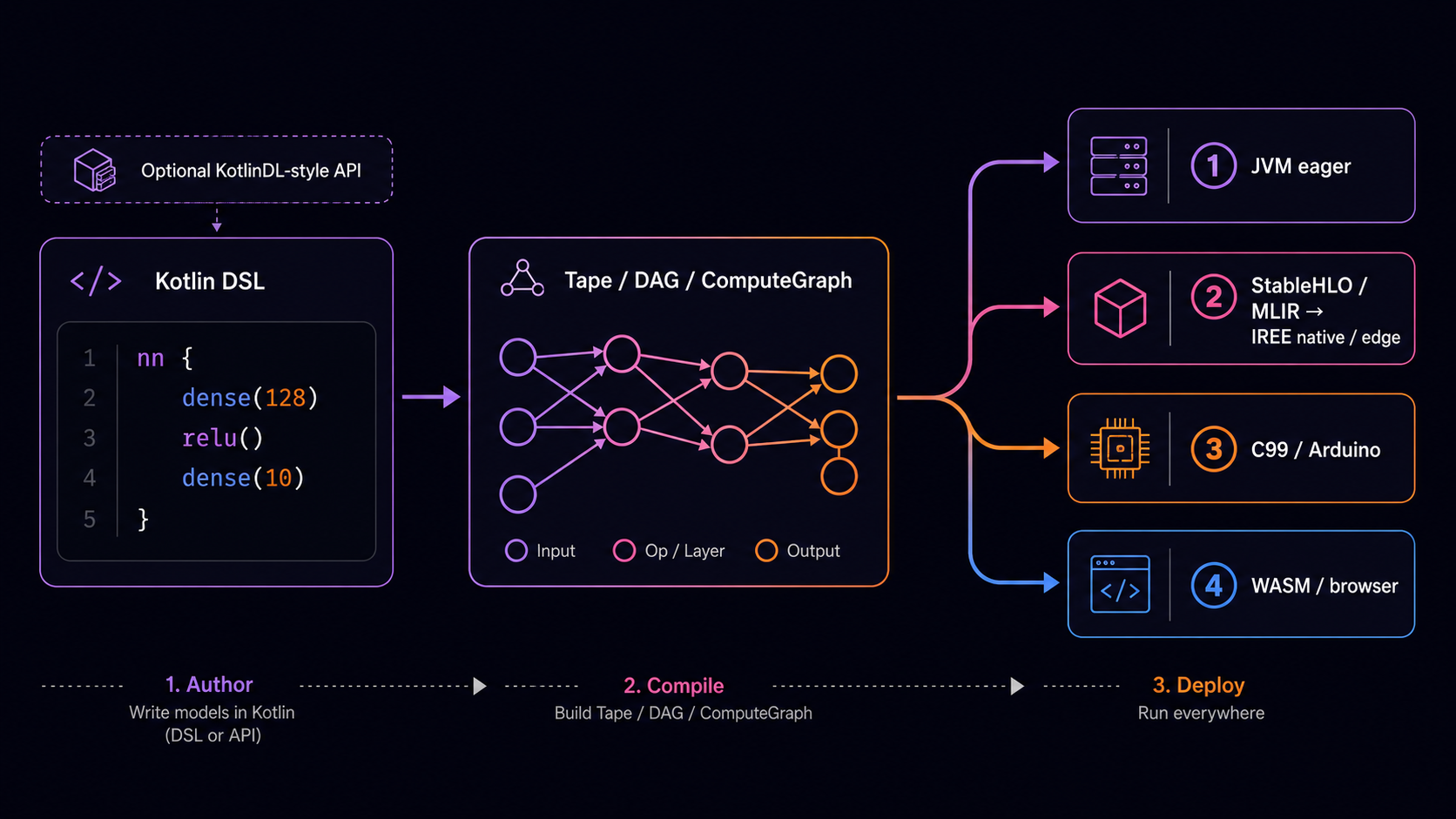
Click the diagram for the full architecture reference, or read the short ARCHITECTURE.md.
SKaiNET is a Kotlin Multiplatform AI framework. New here? Choose the path that matches what you want to try first.
| Goal | Start here | Time |
|---|---|---|
| Run tensor operations | Quickstart (below) | 2–5 min |
| Build and train a neural net | Hello Neural Net (below) | 5 min |
| Run a local GGUF model | SKaiNET Transformers starter | 5 min after model setup |
| Export a secure MCU bundle | Minerva getting started | 10 min without firmware flashing |
Working in Java? SKaiNET ships first-class Java support — see the Java getting-started guide.
[!NOTE] Looking for LLM inference? Llama, Qwen, Gemma, Apertus, BERT embeddings and GGUF chat models live in SKaiNET-transformers — this repository is the engine underneath it (tensors, NN DSL, compiler, CPU/native backends, GGUF/SafeTensors IO). Depend on the
sk.ainet.transformersartifacts, pinned together by the transformers BOM.
Use the version shown in this README as the source of truth for first-run snippets. If another page shows a different version, please open an issue or PR.
Add the core dependencies (Gradle Kotlin DSL):
dependencies {
    // Recommended: import the umbrella BOM and drop versions on the engine modules.
    implementation(platform("sk.ainet:skainet-bom:0.58.0"))

    implementation("sk.ainet.core:skainet-lang-core")
    implementation("sk.ainet.core:skainet-backend-cpu")
}val model = nn {
input(28 * 28)
dense(out = 128)
relu()
dense(out = 10)
}val a = tensor(shape(2, 2)) { float(1f, 2f, 3f, 4f) }
val b = tensor(shape(2, 2)) { float(5f, 6f, 7f, 8f) }
val c = a matMul b
val d = c.relu()// Recommended: streaming reader — memory-efficient, supports quantized types
val source = JvmRandomAccessSource.open("model.gguf")
StreamingGGUFReader.open(source).use { reader ->
println("Tensors: ${reader.tensorCount}")
// Load specific tensor on demand (no whole-file loading)
val bytes = reader.loadTensor("token_embd.weight")
// Or get a TensorStorage descriptor with encoding/placement metadata
val storage = reader.loadTensorStorage("token_embd.weight")
}More examples: SKaiNET-examples | SKaiNET-notebook
SKaiNET is a modular ecosystem. While this repository contains the core engine, specialized high-level libraries are maintained in standalone repositories:
| Project | Description |
|---|---|
| SKaiNET-transformers | Pre-built transformer architectures and layers |
| SKaiNET-examples | Sample projects and integration demos |
| Goal | Start here |
|---|---|
| Examples and sample projects | SKaiNET-examples |
| Interactive notebooks | SKaiNET-notebook |
| Eager backends & kernels (what runs where) | Backends & kernels map |
| Design proposals and long-lived API decisions | SKEEP proposals |
| Memory & storage architecture (storage, views, scopes, planning) | The memory model · Packed weight layout |
First time here? Three links are all you need:
skill:android, skill:numerics (no Kotlin), skill:docs, or by size: size:xs.[Lane N · skill] title prefix means.Small fixes can go straight through the normal contribution flow described in CONTRIBUTING.md and GITFLOW.adoc.
Non-trivial work goes through one of two processes:
docs/modules/skeep/pages/ with three-digit numbering. See the
SKEEP index.SKaiNET ships an official Phoronix-Test-Suite-compatible benchmark
program for the compute engine. See the
methodology and replay docs,
the release manifest, and the
CI workflow. Smoke runs fire
on every PR via ubuntu-latest; full publishable runs fire on a
self-hosted Linux x86 runner on release.
Quick local replay:
./gradlew :skainet-backends:benchmarks:jvm-cpu-publish:shadowJar
./scripts/run_engine_smoke.shSKaiNET is built around one path: a model is defined once in the Kotlin DSL, then either compiled or executed eagerly — without rewriting it.
nn { } / dag { }).ComputeGraph.ComputeGraph through one of several
sibling code-generation backends, each emitting code for a different target
from the same graph:
HloGenerator) → IREE-compilable, for native / edge /
accelerator targets and the wider MLIR ecosystem.StableHLO/MLIR is therefore one code-generation backend among siblings — the IREE/native path next to the C99/Arduino and Minerva MCU paths — not a separate pipeline.
flowchart LR
    DSL["Model — Kotlin DSL"] --> Graph["Tape / DAG (ComputeGraph)"]
    Graph --> Eager["Eager backend (JVM, …)"]
    Graph -->|code generation| HLO["StableHLO / MLIR"]
    Graph -->|code generation| C99["Arduino / C99"]
    Graph -->|code generation| Minerva["Minerva"]
    HLO --> Native["IREE → native / edge / accelerator"]
    C99 --> MCU["Microcontroller"]
    Minerva --> SecMCU["Secure-MCU bundle"]
The same DSL model feeds every path: eager execution for development and JVM deployment, and the code-generation backends — StableHLO/MLIR (→ IREE), Arduino/C99, and Minerva — as sibling alternatives for native, edge, and secure-MCU targets.
SKaiNET now includes a Minerva export backend for secure MCU deployment. It is a sibling to StableHLO and Arduino/C99 export: it starts from a supported ComputeGraph, lowers static MLPs to a Minerva compiler input, invokes libminerva when configured, and packages generated weights, host fixtures, firmware skeletons, and a fingerprinted manifest.json.
Start here:
Runnable examples:
./gradlew :skainet-compile:skainet-compile-minerva:runMinervaSecureMcuExamples
./gradlew :skainet-compile:skainet-compile-minerva:runMinervaSecureMcuExamples \
-Pminerva.example=sensor-classifiersafe-lowbit, balanced, experimental-max. See TurboQuantUsage for integration guide.nn { input(); dense(); relu(); dense() }
dag { } for ResNet, YOLO-style architecturesfile://, https://, hf+https://, and hf://...
.jsonl, .ndjson)val raw = JvmDataSourceResolver().rawDataset {
from("hf://datasets/org/repo@main/train.jsonl")
format(DataFormat.JSON_LINES)
cachePolicy(CachePolicy.Use)
}
val withoutLabel = dataPipeline<RawDataset>()
.stage(
dataTransformer(
name = "drop-label",
outputSchema = { schema -> DataSchema(schema.columns - "label") }
) { dataset ->
val columns = dataset.schema.columns - "label"
dataset.copy(
schema = DataSchema(columns),
rows = dataset.rows.map { row ->
RawDataRow(row.values.filterKeys { key -> key in columns })
}
)
}
)
.execute(raw)HloGenerator
Input front ends and model identity land as SKEEP-006:
skainet-frontend-core defines
FrontEnd, FrontEndSpec and the text, audio, image and multimodal contracts; a resolver turns a
checkpoint view into the front ends a model needs. The text lane ships in skainet-frontend-text.tokenizers library guards exact id parity for GPT-2, Qwen2.5,
TinyLlama, T5, BERT, Gemma 4 and the two public Laya tokenizers.skainet-model-identity carries ModelIdentity, CheckpointView
and an immutable ModelFamilyRegistry; the old enum-style detection is deprecated.See CHANGELOG.md for full release notes, including every prior release.
We love contributions! Whether it's a new operator, documentation, or a bug fix:
Browse the full codebase documentation on DeepWiki.
scaledDotProductAttention and its StableHLO lowering, structural schedule defaults, and
schedule-aware graph execution contexts (SKEEP-005 phase 2)BufferHandle.Floats path, and the sharded SafeTensors loaderViewKernelPack SPI, dense FP32 for mapped/off-heap
storage, the decode-shaped FP32 kernel work, Android-native targets across the downstream
chain, and the ternary packs joining the self-healing SPISEQUENTIAL I2_S, the AOT GGUF converter and its IREE-facing
counterpart in SKaiNET-IREE-tools, and the scoped dense-FP32 activation matmul-chooser fixtranspose() block-grid correctness fix, all three kernel tiers (#968, #969)DEQUANTIZE_TO_FP32 over-allocation fix (#782), native Q5_0/Q5_1 packed matmul kernels (#708), Apple arm64 runtime FEAT_DotProd dispatch (#958), Apple iOS/macOS Kotlin/Native kernel targets (#959)createRandomAccessSource streaming loads (#922), cinterop klib archive embedding (#942), Q4_0 NEON kernel (#939), GGUF loader fail-fast (#919), tensor-storage correctness fixes (#927, #928, #929, #930, #931), AAR release publishing (#947)Lstm layer (#824), Dropout masking (#867), LR schedules (#866), optional/open Linear (#870, #875), SDPA scale fix (#880), autograd fixes (#877), argMax DAG spec (#878), tokenizer + gather fixes (#879), Android native IO targets (#836, #842, #845)If you use SKaiNET in your research, please cite it. Citation metadata lives in
CITATION.cff (GitHub's Cite this repository button exports BibTeX and APA
from it). Ready-to-paste BibTeX:
@misc{skainet,
  author       = {Harakal, Michal and {SKaiNET-developers contributors}},
  title        = {{SKaiNET}: A {Kotlin} Multiplatform {AI} Framework},
  year         = {2026},
  note         = {Version 0.58.0. MIT License},
  howpublished = {\url{https://github.com/SKaiNET-developers/SKaiNET}}
}
Please include the version you used (each release is tagged).
MIT — see LICENCE.
Click the diagram for the full architecture reference, or read the short ARCHITECTURE.md.
SKaiNET is a Kotlin Multiplatform AI framework. New here? Choose the path that matches what you want to try first.
| Goal | Start here | Time |
|---|---|---|
| Run tensor operations | Quickstart (below) | 2–5 min |
| Build and train a neural net | Hello Neural Net (below) | 5 min |
| Run a local GGUF model | SKaiNET Transformers starter | 5 min after model setup |
| Export a secure MCU bundle | Minerva getting started | 10 min without firmware flashing |
Working in Java? SKaiNET ships first-class Java support — see the Java getting-started guide.
[!NOTE] Looking for LLM inference? Llama, Qwen, Gemma, Apertus, BERT embeddings and GGUF chat models live in SKaiNET-transformers — this repository is the engine underneath it (tensors, NN DSL, compiler, CPU/native backends, GGUF/SafeTensors IO). Depend on the
sk.ainet.transformersartifacts, pinned together by the transformers BOM.
Use the version shown in this README as the source of truth for first-run snippets. If another page shows a different version, please open an issue or PR.
Add the core dependencies (Gradle Kotlin DSL):
dependencies {
    // Recommended: import the umbrella BOM and drop versions on the engine modules.
    implementation(platform("sk.ainet:skainet-bom:0.58.0"))

    implementation("sk.ainet.core:skainet-lang-core")
    implementation("sk.ainet.core:skainet-backend-cpu")
}val model = nn {
input(28 * 28)
dense(out = 128)
relu()
dense(out = 10)
}val a = tensor(shape(2, 2)) { float(1f, 2f, 3f, 4f) }
val b = tensor(shape(2, 2)) { float(5f, 6f, 7f, 8f) }
val c = a matMul b
val d = c.relu()// Recommended: streaming reader — memory-efficient, supports quantized types
val source = JvmRandomAccessSource.open("model.gguf")
StreamingGGUFReader.open(source).use { reader ->
println("Tensors: ${reader.tensorCount}")
// Load specific tensor on demand (no whole-file loading)
val bytes = reader.loadTensor("token_embd.weight")
// Or get a TensorStorage descriptor with encoding/placement metadata
val storage = reader.loadTensorStorage("token_embd.weight")
}More examples: SKaiNET-examples | SKaiNET-notebook
SKaiNET is a modular ecosystem. While this repository contains the core engine, specialized high-level libraries are maintained in standalone repositories:
| Project | Description |
|---|---|
| SKaiNET-transformers | Pre-built transformer architectures and layers |
| SKaiNET-examples | Sample projects and integration demos |
| Goal | Start here |
|---|---|
| Examples and sample projects | SKaiNET-examples |
| Interactive notebooks | SKaiNET-notebook |
| Eager backends & kernels (what runs where) | Backends & kernels map |
| Design proposals and long-lived API decisions | SKEEP proposals |
| Memory & storage architecture (storage, views, scopes, planning) | The memory model · Packed weight layout |
First time here? Three links are all you need:
skill:android, skill:numerics (no Kotlin), skill:docs, or by size: size:xs.[Lane N · skill] title prefix means.Small fixes can go straight through the normal contribution flow described in CONTRIBUTING.md and GITFLOW.adoc.
Non-trivial work goes through one of two processes:
docs/modules/skeep/pages/ with three-digit numbering. See the
SKEEP index.SKaiNET ships an official Phoronix-Test-Suite-compatible benchmark
program for the compute engine. See the
methodology and replay docs,
the release manifest, and the
CI workflow. Smoke runs fire
on every PR via ubuntu-latest; full publishable runs fire on a
self-hosted Linux x86 runner on release.
Quick local replay:
./gradlew :skainet-backends:benchmarks:jvm-cpu-publish:shadowJar
./scripts/run_engine_smoke.shSKaiNET is built around one path: a model is defined once in the Kotlin DSL, then either compiled or executed eagerly — without rewriting it.
nn { } / dag { }).ComputeGraph.ComputeGraph through one of several
sibling code-generation backends, each emitting code for a different target
from the same graph:
HloGenerator) → IREE-compilable, for native / edge /
accelerator targets and the wider MLIR ecosystem.StableHLO/MLIR is therefore one code-generation backend among siblings — the IREE/native path next to the C99/Arduino and Minerva MCU paths — not a separate pipeline.
flowchart LR
    DSL["Model — Kotlin DSL"] --> Graph["Tape / DAG (ComputeGraph)"]
    Graph --> Eager["Eager backend (JVM, …)"]
    Graph -->|code generation| HLO["StableHLO / MLIR"]
    Graph -->|code generation| C99["Arduino / C99"]
    Graph -->|code generation| Minerva["Minerva"]
    HLO --> Native["IREE → native / edge / accelerator"]
    C99 --> MCU["Microcontroller"]
    Minerva --> SecMCU["Secure-MCU bundle"]
The same DSL model feeds every path: eager execution for development and JVM deployment, and the code-generation backends — StableHLO/MLIR (→ IREE), Arduino/C99, and Minerva — as sibling alternatives for native, edge, and secure-MCU targets.
SKaiNET now includes a Minerva export backend for secure MCU deployment. It is a sibling to StableHLO and Arduino/C99 export: it starts from a supported ComputeGraph, lowers static MLPs to a Minerva compiler input, invokes libminerva when configured, and packages generated weights, host fixtures, firmware skeletons, and a fingerprinted manifest.json.
Start here:
Runnable examples:
./gradlew :skainet-compile:skainet-compile-minerva:runMinervaSecureMcuExamples
./gradlew :skainet-compile:skainet-compile-minerva:runMinervaSecureMcuExamples \
-Pminerva.example=sensor-classifiersafe-lowbit, balanced, experimental-max. See TurboQuantUsage for integration guide.nn { input(); dense(); relu(); dense() }
dag { } for ResNet, YOLO-style architecturesfile://, https://, hf+https://, and hf://...
.jsonl, .ndjson)val raw = JvmDataSourceResolver().rawDataset {
from("hf://datasets/org/repo@main/train.jsonl")
format(DataFormat.JSON_LINES)
cachePolicy(CachePolicy.Use)
}
val withoutLabel = dataPipeline<RawDataset>()
.stage(
dataTransformer(
name = "drop-label",
outputSchema = { schema -> DataSchema(schema.columns - "label") }
) { dataset ->
val columns = dataset.schema.columns - "label"
dataset.copy(
schema = DataSchema(columns),
rows = dataset.rows.map { row ->
RawDataRow(row.values.filterKeys { key -> key in columns })
}
)
}
)
.execute(raw)HloGenerator
Input front ends and model identity land as SKEEP-006:
skainet-frontend-core defines
FrontEnd, FrontEndSpec and the text, audio, image and multimodal contracts; a resolver turns a
checkpoint view into the front ends a model needs. The text lane ships in skainet-frontend-text.tokenizers library guards exact id parity for GPT-2, Qwen2.5,
TinyLlama, T5, BERT, Gemma 4 and the two public Laya tokenizers.skainet-model-identity carries ModelIdentity, CheckpointView
and an immutable ModelFamilyRegistry; the old enum-style detection is deprecated.See CHANGELOG.md for full release notes, including every prior release.
We love contributions! Whether it's a new operator, documentation, or a bug fix:
Browse the full codebase documentation on DeepWiki.
scaledDotProductAttention and its StableHLO lowering, structural schedule defaults, and
schedule-aware graph execution contexts (SKEEP-005 phase 2)BufferHandle.Floats path, and the sharded SafeTensors loaderViewKernelPack SPI, dense FP32 for mapped/off-heap
storage, the decode-shaped FP32 kernel work, Android-native targets across the downstream
chain, and the ternary packs joining the self-healing SPISEQUENTIAL I2_S, the AOT GGUF converter and its IREE-facing
counterpart in SKaiNET-IREE-tools, and the scoped dense-FP32 activation matmul-chooser fixtranspose() block-grid correctness fix, all three kernel tiers (#968, #969)DEQUANTIZE_TO_FP32 over-allocation fix (#782), native Q5_0/Q5_1 packed matmul kernels (#708), Apple arm64 runtime FEAT_DotProd dispatch (#958), Apple iOS/macOS Kotlin/Native kernel targets (#959)createRandomAccessSource streaming loads (#922), cinterop klib archive embedding (#942), Q4_0 NEON kernel (#939), GGUF loader fail-fast (#919), tensor-storage correctness fixes (#927, #928, #929, #930, #931), AAR release publishing (#947)Lstm layer (#824), Dropout masking (#867), LR schedules (#866), optional/open Linear (#870, #875), SDPA scale fix (#880), autograd fixes (#877), argMax DAG spec (#878), tokenizer + gather fixes (#879), Android native IO targets (#836, #842, #845)If you use SKaiNET in your research, please cite it. Citation metadata lives in
CITATION.cff (GitHub's Cite this repository button exports BibTeX and APA
from it). Ready-to-paste BibTeX:
@misc{skainet,
  author       = {Harakal, Michal and {SKaiNET-developers contributors}},
  title        = {{SKaiNET}: A {Kotlin} Multiplatform {AI} Framework},
  year         = {2026},
  note         = {Version 0.58.0. MIT License},
  howpublished = {\url{https://github.com/SKaiNET-developers/SKaiNET}}
}
Please include the version you used (each release is tagged).
MIT — see LICENCE.