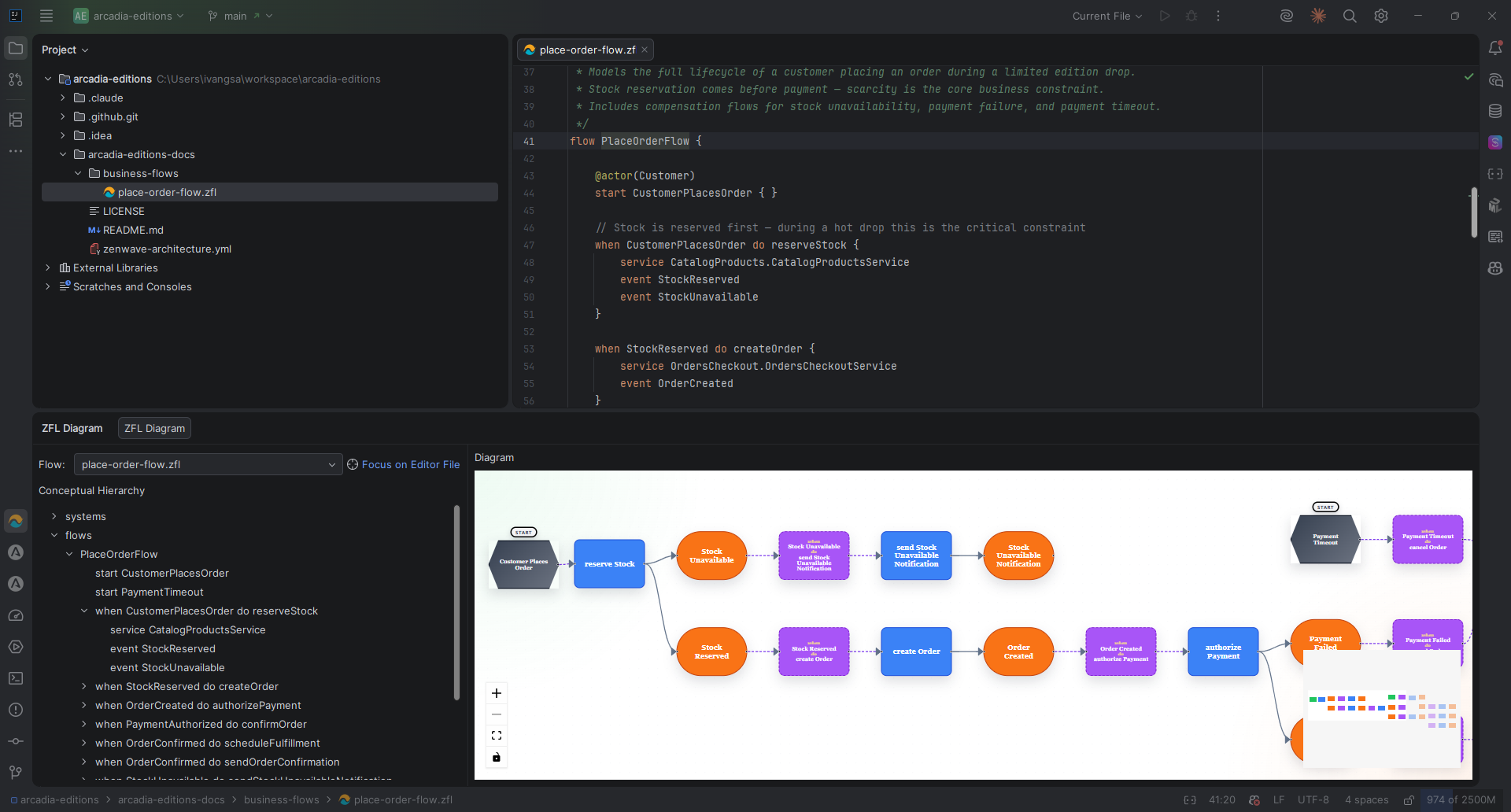
Domain-specific language modeling event-driven architectures using DDD concepts, keeping business vocabulary and compact syntax; parses EventStorming discoveries into docs, diagrams, OpenAPI/AsyncAPI and backend artifacts.




dsl-kotlin provides Kotlin Multiplatform parsers for both ZDL and ZFL.
Both languages are designed to be developer-friendly, compact, and machine-readable so they can be parsed and converted into software artifacts such as:

Usage:
<dependency>
    <groupId>io.zenwave360.dsl</groupId>
    <artifactId>dsl-kotlin-jvm</artifactId>
    <version>${dsl-kotlin.version}</version>
</dependency>
String zdlContent = "...";
ZdlParser parser = new ZdlParser();
ZdlModel model = parser.parseModel(zdlContent);
String zflContent = "...";
ZflParser flowParser = new ZflParser();
ZflModel flowModel = flowParser.parseModel(zflContent);NOTE: JVM version includes working ZdlParser and ZflParser implementations compiled from the Kotlin ANTLR4 target and also the Java target parser/lexer classes used by intellij-antlr-adapter.
For package build and publishing instructions, see Publishing to npm.
npm install @zenwave360/dsl@nextThe next tag selects the opt-in prerelease train. Stable releases use latest.
import { parseZdl } from '@zenwave360/dsl';
import { parseZfl } from '@zenwave360/dsl';

const zdlContent = "...";
const zdlModel = parseZdl(zdlContent);

const zflContent = "...";
const zflModel = parseZfl(zflContent);
ZDL plugin option source spans are available in model.locations under
pluginsList.<n>.config.<option> and pluginsList.<n>.cliOptions.<option>.
Each declaration has a span; its .value span covers only the value, including
quote delimiters. A CLI flag without a value has no .value span. The first two
span entries are the start offset and exclusive end offset in the original
source, suitable for source.slice(span[0], span[1]). Model values are unchanged.
model.pluginsList is every plugin declaration in order. Each instance's
declaration span is locations['pluginsList.N'].
CLI options may also be declared directly inside config, before plugins,
for consumers that apply shared command-line defaults. They are reported in
model.cliOptions; their spans use cliOptions.<option> and
cliOptions.<option>.value, with no value span for a valueless flag.
These spans are implemented in shared Kotlin source. JS consumers must rebuild
the package with ./gradlew jsProductionExecutableCompileSync and update their
bundled or installed artifact; an existing JS bundle does not gain them automatically.
Numbers in parseZdl and parseZfl output are plain JavaScript values: an integer is a JS
number (for example maxDepth 3 gives 3), or its exact decimal string when it lies beyond
Number.MAX_SAFE_INTEGER (±(2^53 - 1)). Decimals stay strings (ratio 1.25 gives "1.25"),
as in the JVM model. Negative literals keep their sign (neg -2 gives -2).
Before 1.10.0 an integer was an opaque Kotlin Long object with compiler-generated field names
({"h2_1":3,"i2_1":0}) and the sign of a negative literal was dropped; JS consumers that worked
around either should read the value directly. The JVM model is unchanged (Long and String).
The repository builds three modules:
| Module | Maven artifact | Content |
|---|---|---|
dsl-kotlin |
io.zenwave360.dsl:dsl-kotlin |
ZDL and ZFL parsers, semantic models, event flow view models; npm @zenwave360/dsl
|
dsl-views |
io.zenwave360.dsl:dsl-views |
Mermaid diagrams from ZDL and ZFL models: class diagram, flows, and the architecture of several ZDL modules; see dsl-views/README.md |
dsl-docs |
io.zenwave360.dsl:dsl-docs |
Markdown documentation with those diagrams, from ZDL, ZFL, OpenAPI and AsyncAPI files; see dsl-docs/README.md |
ZDL class diagrams and ZFL flowcharts and sequence diagrams are Mermaid text from dsl-views:
val classDiagram = GenerateMermaidFromZdl().execute(zdlContent)
val flowDiagrams = GenerateMermaidFromZfl().execute(zflContent)
The class diagram contains aggregates with their commands, entities with their fields, enums with their
values, inputs, outputs and events, services with their commands, and relationships with their
cardinality. It contains no click, link or callback directives and no remote references.
dsl-views and dsl-docs are not published to npm yet.
The JS package loads in browsers and Web Workers as well as in Node.js: ./gradlew check
runs jsBrowserTest in a headless Chromium-based browser (Karma; set CHROME_BIN, or a local
Chrome, Chromium or Edge is used).
dsl-kotlin provides Kotlin Multiplatform parsers for both ZDL and ZFL.
Both languages are designed to be developer-friendly, compact, and machine-readable so they can be parsed and converted into software artifacts such as:
Usage:
<dependency>
    <groupId>io.zenwave360.dsl</groupId>
    <artifactId>dsl-kotlin-jvm</artifactId>
    <version>${dsl-kotlin.version}</version>
</dependency>
String zdlContent = "...";
ZdlParser parser = new ZdlParser();
ZdlModel model = parser.parseModel(zdlContent);
String zflContent = "...";
ZflParser flowParser = new ZflParser();
ZflModel flowModel = flowParser.parseModel(zflContent);NOTE: JVM version includes working ZdlParser and ZflParser implementations compiled from the Kotlin ANTLR4 target and also the Java target parser/lexer classes used by intellij-antlr-adapter.
For package build and publishing instructions, see Publishing to npm.
npm install @zenwave360/dsl@nextThe next tag selects the opt-in prerelease train. Stable releases use latest.
import { parseZdl } from '@zenwave360/dsl';
import { parseZfl } from '@zenwave360/dsl';

const zdlContent = "...";
const zdlModel = parseZdl(zdlContent);

const zflContent = "...";
const zflModel = parseZfl(zflContent);
ZDL plugin option source spans are available in model.locations under
pluginsList.<n>.config.<option> and pluginsList.<n>.cliOptions.<option>.
Each declaration has a span; its .value span covers only the value, including
quote delimiters. A CLI flag without a value has no .value span. The first two
span entries are the start offset and exclusive end offset in the original
source, suitable for source.slice(span[0], span[1]). Model values are unchanged.
model.pluginsList is every plugin declaration in order. Each instance's
declaration span is locations['pluginsList.N'].
CLI options may also be declared directly inside config, before plugins,
for consumers that apply shared command-line defaults. They are reported in
model.cliOptions; their spans use cliOptions.<option> and
cliOptions.<option>.value, with no value span for a valueless flag.
These spans are implemented in shared Kotlin source. JS consumers must rebuild
the package with ./gradlew jsProductionExecutableCompileSync and update their
bundled or installed artifact; an existing JS bundle does not gain them automatically.
Numbers in parseZdl and parseZfl output are plain JavaScript values: an integer is a JS
number (for example maxDepth 3 gives 3), or its exact decimal string when it lies beyond
Number.MAX_SAFE_INTEGER (±(2^53 - 1)). Decimals stay strings (ratio 1.25 gives "1.25"),
as in the JVM model. Negative literals keep their sign (neg -2 gives -2).
Before 1.10.0 an integer was an opaque Kotlin Long object with compiler-generated field names
({"h2_1":3,"i2_1":0}) and the sign of a negative literal was dropped; JS consumers that worked
around either should read the value directly. The JVM model is unchanged (Long and String).
The repository builds three modules:
| Module | Maven artifact | Content |
|---|---|---|
dsl-kotlin |
io.zenwave360.dsl:dsl-kotlin |
ZDL and ZFL parsers, semantic models, event flow view models; npm @zenwave360/dsl
|
dsl-views |
io.zenwave360.dsl:dsl-views |
Mermaid diagrams from ZDL and ZFL models: class diagram, flows, and the architecture of several ZDL modules; see dsl-views/README.md |
dsl-docs |
io.zenwave360.dsl:dsl-docs |
Markdown documentation with those diagrams, from ZDL, ZFL, OpenAPI and AsyncAPI files; see dsl-docs/README.md |
ZDL class diagrams and ZFL flowcharts and sequence diagrams are Mermaid text from dsl-views:
val classDiagram = GenerateMermaidFromZdl().execute(zdlContent)
val flowDiagrams = GenerateMermaidFromZfl().execute(zflContent)
The class diagram contains aggregates with their commands, entities with their fields, enums with their
values, inputs, outputs and events, services with their commands, and relationships with their
cardinality. It contains no click, link or callback directives and no remote references.
dsl-views and dsl-docs are not published to npm yet.
The JS package loads in browsers and Web Workers as well as in Node.js: ./gradlew check
runs jsBrowserTest in a headless Chromium-based browser (Karma; set CHROME_BIN, or a local
Chrome, Chromium or Edge is used).