
High-performance, lock-free bounded priority queue using persistent treap and CAS-based atomic updates; automatic eviction, key-based upsert deduplication, O(1) lookup, reactive state and batch mutations.
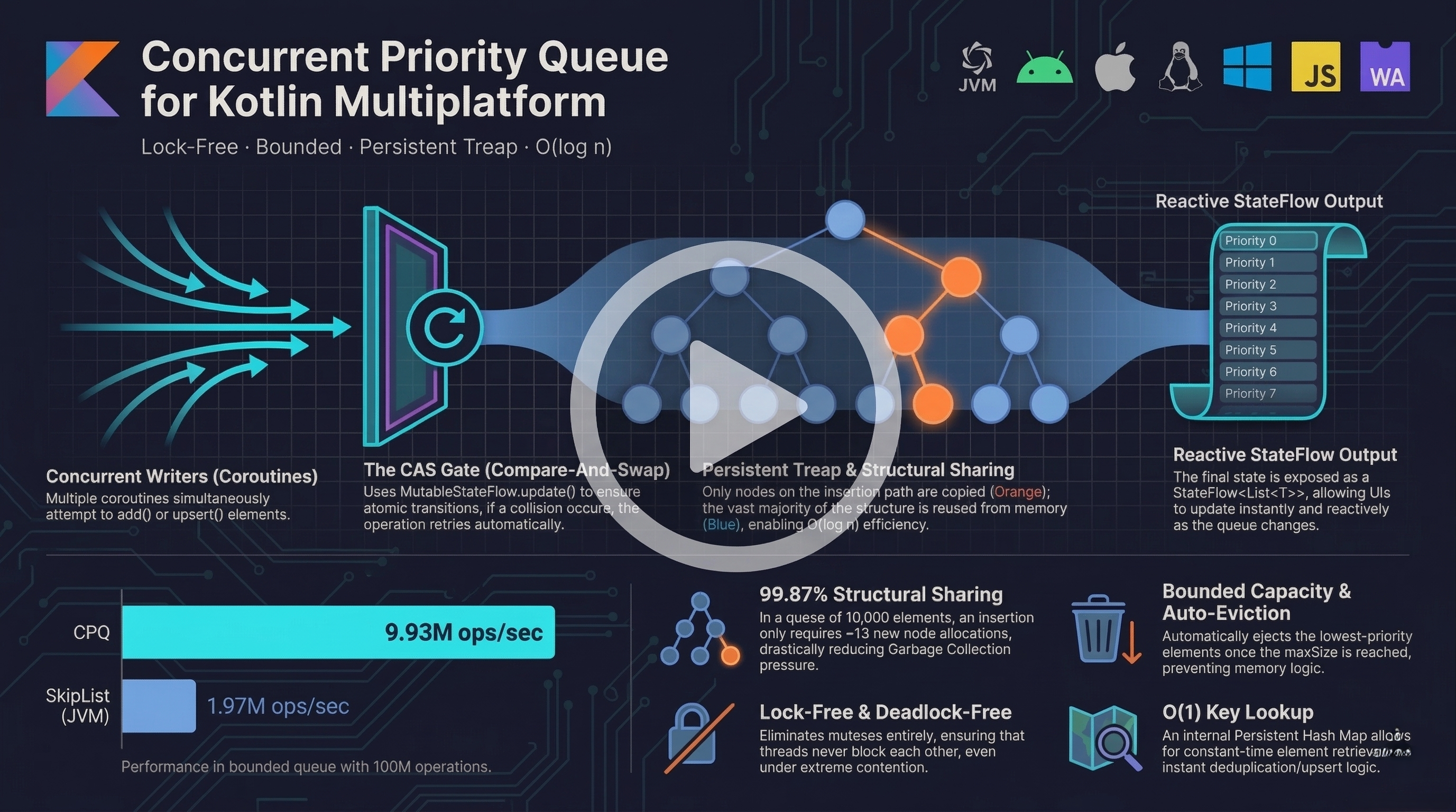
A high-performance, lock-free, bounded priority queue for Kotlin Multiplatform. Built on a persistent Treap data structure combined with MutableStateFlow for thread-safe atomic updates via CAS (Compare-And-Swap). Designed for concurrent environments where many coroutines or threads insert, update, and remove elements simultaneously — without blocking.



MutableStateFlow.update() with CAS for non-blocking atomic updates. No mutexes, no locks, no deadlocks.maxSize is reached.StateFlow<List<T>> for seamless UI binding with Jetpack Compose, SwiftUI, or any reactive framework.builder() or mutate { ... } that bypass per-operation CAS overhead.// build.gradle.kts
commonMain.dependencies {
implementation("io.github.karloti:concurrent-priority-queue:1.3.5") // <- Use latest version
}The library transitively provides kotlinx-coroutines-core, so you don't need to declare it separately for StateFlow and Flow types.
By default, the queue uses natural order (ascending), meaning smaller values have higher priority.
// Keep the 5 smallest integers (min-priority queue)
val queue = ConcurrentPriorityQueue<Int>(maxSize = 5)

queue.add(10)
queue.add(50)
queue.add(20)
queue.add(5)
queue.add(1)
queue.add(100) // Rejected — larger than all current top 5

println(queue.items.value)  // [1, 5, 10, 20, 50]
data class SearchResult(val id: String, val score: Int)

val queue = ConcurrentPriorityQueue<SearchResult, String>(
    maxSize = 3,
    comparator = compareByDescending { it.score },  // Higher score = higher priority
    uniqueKeySelector = { it.id }
)

queue.add(SearchResult("A", 10))
queue.add(SearchResult("B", 20))
queue.add(SearchResult("A", 30))  // Updates "A" to score 30 (better priority)
queue.add(SearchResult("A", 5))   // Rejected — existing score 30 is better
queue.add(SearchResult("C", 15))

println(queue.items.value)
// [SearchResult(id=A, score=30), SearchResult(id=B, score=20), SearchResult(id=C, score=15)]
data class Task(val id: String, val deadline: Long)

val taskQueue = ConcurrentPriorityQueue<Task, String>(
    maxSize = 100,
    comparator = compareBy { it.deadline },  // Earlier deadline = higher priority
    uniqueKeySelector = { it.id }
)

taskQueue.add(Task("backup", 1735689600))
taskQueue.add(Task("critical-fix", 1735603200))

println(taskQueue.first())  // Task(id=critical-fix, ...)
val next = taskQueue.poll() // Removes and returns the highest priority task
@Composable
fun LeaderboardScreen(queue: ConcurrentPriorityQueue<Score, String>) {
    val topScores by queue.items.collectAsState()

    LazyColumn {
        items(topScores) { score ->
            Text("${score.name}: ${score.value}")
        }
    }
}
// Efficiently apply multiple changes without per-operation CAS overhead
val updated = queue.mutate {
    add(Task("task-1", 10))
    add(Task("task-2", 5))
    add(Task("task-3", 20))
    removeIf { it.priority > 15 }
    poll()  // Remove highest priority
}
// `updated` is a new ConcurrentPriorityQueue with all changes applied
data class Task(val id: String, val priority: Int, val completed: Boolean)

val queue = ConcurrentPriorityQueue<Task, String>(
    maxSize = 100,
    comparator = compareBy { it.priority },
    uniqueKeySelector = { it.id }
)

// Add multiple elements at once
queue.addAll(listOf(
    Task("task-1", 10, false),
    Task("task-2", 5, false),
    Task("task-3", 20, true)
))

// Remove completed tasks
val removedCount = queue.removeIf { it.completed }  // 1

// Keep only high-priority tasks (priority <= 10)
queue.retainIf { it.priority <= 10 }

// Poll highest priority task
val nextTask = queue.poll()  // Task(id=task-2, priority=5)

// Clear all remaining
queue.clear()The library is structured following Kotlin conventions inspired by kotlinx.collections.immutable:
 A class hierarchy diagram showing the three inheritance trees described above, with clear interface/class distinction, using UML-style notation with Kotlin-themed colors (purple/violet).
The queue is backed by a persistent (immutable) Treap — a randomized binary search tree that combines two properties:
The key insight: randomness replaces complexity. Red-Black trees need 5 invariant rules and cascading recoloring. AVL trees need height tracking and up to O(log n) rotations per insert. A Treap needs only one rule — "parent priority > child priority" — enforced by a single rotation when violated. The random priorities ensure that, on average, the tree is as balanced as if the elements were inserted in random order, regardless of the actual insertion order.
When inserting a new element, the algorithm performs two phases:
Phase 1 — Descent and path recording:
The algorithm iteratively descends the tree following BST order (comparator) until it reaches a null position, recording the path from root to insertion point in an ArrayList and tracking left/right directions in a Long bitmask. The iterative approach guarantees constant stack usage regardless of tree size — no risk of stack overflow even for queues with millions of elements.
 Step 1: Insert(15) — the algorithm descends to a null position and creates leaf 15. Then, walking the recorded path bottom-up, nodes 10, 20, 30 are copied with references to the new child (path copying). Nodes 25, 40, 50 are shared (blue) — zero allocation for them. Note: node 15 (priority 0.21) > parent 10' (priority 0.12) — heap property is violated, rotation needed (see Step 2).
Phase 2 — Bottom-up reconstruction with fused rotations:
The algorithm walks the recorded path in reverse (bottom-up), reconstructing nodes with path copying. At each level it checks: does the newly inserted child have a higher priority than its parent? If yes, a fused rotation moves the child up — combining the node copy and rotation into a single allocation (instead of two). Rotations stop as soon as the heap property is satisfied.
 Step 2: rotateLeft(10') — node 15 (priority 0.21) has higher priority than parent 10 (priority 0.12), so a left rotation makes 15 the parent and 10 becomes its left child. Now 15' (0.21) < 20' (0.45) — heap property satisfied, no more rotations needed.
Total allocations for insert(15): 5 new nodes (30', 20', 15', 10'', and the leaf 15). Shared (zero-copy): 3 nodes (50, 25, 40). Without structural sharing, all 7 nodes of the resulting tree would require fresh allocation. Fused rotations produce the rotation output (15' and 10'') in a single allocation step — a naive implementation would first copy the parent, then rotate, creating an intermediate node that is immediately discarded.
Scaling perspective: In this small tree (6 nodes), structural sharing saves just 1 allocation. But in a tree with 10,000 nodes, an insert copies only ~13 nodes (log₂ 10,000) while sharing the remaining ~9,987 — a 99.87% reduction in allocation.
Each version of the queue (each immutable snapshot) consists of two synchronized persistent structures:
Treap (Node<T, K>) — A binary tree where each node stores the element, its key, a random priority, left/right child references, and a subtree size counter. The subtree size enables O(log n) indexed access (get(index)) without traversing the entire tree. In-order traversal yields elements in sorted (comparator) order.
PersistentHashMap (PersistentMap<K, T> from kotlinx.collections.immutable) — A Hash Array Mapped Trie (HAMT) that maps keys to elements, providing O(1) key lookup. This powers contains(key), get(key), and the upsert check: "does this key already exist, and is the new element strictly better by comparator?" Without this map, key lookup would require O(log n) tree traversal.
Both structures are fully immutable. Every mutation produces a new Treap root and a new PersistentMap, wrapped together in a new TreapPriorityList instance. The ConcurrentPriorityQueue then atomically swaps this instance into its MutableStateFlow via CAS.
How the upsert works (step by step):
this, zero allocation).Priority generation: Each node's treap priority is a fully random Long generated by Random.nextLong() at insertion time. Pure randomness is critical — it ensures expected O(log n) tree depth regardless of the actual insertion order or element type. Using hashCode() as part of the priority would be a mistake: for types like Int (where hashCode() == value), the priority would correlate with comparator order, producing degenerate O(n)-depth trees instead of balanced O(log n) ones.
Why Treap over Red-Black Tree or AVL?
| Property | Treap | Red-Black Tree | AVL Tree |
|---|---|---|---|
| Balance guarantee | Expected O(log n) | Worst-case O(log n) | Worst-case O(log n) |
| Rebalancing complexity | Single rotation per level | 5 color rules, cascading recoloring | Height tracking, double rotations |
| Persistent-friendly | Excellent (path-copy only) | Difficult (recoloring propagates up) | Moderate (height updates propagate) |
| Nodes touched per insert | O(log n) path only | O(log n) + recoloring ancestors | O(log n) + height updates |
| Implementation size | ~100 lines | ~300+ lines | ~200+ lines |
The treap's simplicity makes it ideal for persistent data structures where every mutation produces a new root. Unlike Red-Black trees, treap rotations are local and never cascade, which means persistent copies touch minimal nodes. The random priority ("noise") is the secret — it provides probabilistic balance that is indistinguishable from optimal in practice, with none of the implementation complexity.
When maxSize is set, the queue automatically manages capacity:
last(), O(log n) traversal to the rightmost node). If the new element is worse or equal — rejected, zero allocation (no path copying, no new treap version). This avoids the cost of insert + evict (2x O(log n) + allocations), which is why the benchmark shows 5x speedup over ConcurrentSkipListSet for repeated adds to a full queue.size > maxSize, call removeLast() which walks to the rightmost node (the worst element by comparator order) and removes it — O(log n). The evicted element is returned to the caller.How it works: Each mutation reads the current immutable treap, computes a new treap with the change applied, and atomically swaps it in using CAS. If another thread modified the state between read and swap, the operation retries with the updated snapshot. Since the treap is persistent, retries only recompute the delta (O(log n) new nodes), not the entire structure.
No locks, no blocking, no deadlocks. Under contention, threads may retry, but they never wait for each other. This is the same pattern used by Kotlin's MutableStateFlow.update().
 A sequence diagram showing three concurrent threads performing CAS operations. Thread 1 succeeds on first try, Thread 2's CAS fails because Thread 1 changed the state, so Thread 2 retries with the new state and succeeds. Thread 3 observes the final state. Arrows show the flow of read-compute-CAS-retry.
ConcurrentPriorityQueue<T, K>(
    maxSize: Int = 5,
    comparator: Comparator<T>,
    uniqueKeySelector: (T) -> K
)| Parameter | Description |
|---|---|
maxSize |
Maximum queue capacity. Elements beyond this limit are evicted. Must be > 0. |
comparator |
Defines priority order. The first element in sorted order has the highest priority. |
uniqueKeySelector |
Extracts a unique identity key from each element for deduplication. |
// For Comparable types
ConcurrentPriorityQueue<Int>(maxSize = 10)

// Custom comparator (element is its own key)
ConcurrentPriorityQueue<Task>(maxSize = 10, compareBy { it.priority })

// Comparable types with custom key selector
ConcurrentPriorityQueue<Score, String>(maxSize = 10) { it.id }| Method | Return Type | Complexity | Description |
|---|---|---|---|
add(element) |
T? |
O(log n) | Upsert with eviction. Returns the evicted element, or null if no eviction occurred (including rejections). |
addAll(Iterable) |
List<T> |
O(m log n) | Add all elements. Returns a snapshot of the queue contents after processing. |
addAll(Sequence) |
Int |
O(m log n) | Add all elements. Returns the number of non-eviction insertions. |
addAll(Flow) |
Int |
O(m log n) | Suspending. Add all emitted elements. Returns the number of evictions caused. |
| Method | Return Type | Complexity | Description |
|---|---|---|---|
get(key) / [key]
|
T? |
O(1) | Retrieve element by key. |
first() |
T? |
O(log n) | Peek at the highest-priority element. |
last() |
T? |
O(log n) | Peek at the lowest-priority element. |
contains(element) |
Boolean |
O(1) | Check if element exists (by key). |
containsKey(key) |
Boolean |
O(1) | Check if key exists. |
isEmpty() |
Boolean |
O(1) | Check if queue is empty. |
isNotEmpty() |
Boolean |
O(1) | Check if queue has elements. |
size |
Int |
O(1) | Current number of elements. |
items |
StateFlow<List<T>> |
O(1) | Reactive sorted list for UI binding. |
iterator() |
Iterator<T> |
O(n) | Iterate in priority order (snapshot). |
| Method | Return Type | Complexity | Description |
|---|---|---|---|
poll() |
T? |
O(log n) | Remove and return the highest-priority element. |
remove(element) |
Boolean |
O(log n) | Remove element (by key). |
removeByKey(key) |
Boolean |
O(log n) | Remove element by key. |
removeIf { predicate } |
Int |
O(k log n) | Remove all matching elements. Returns count removed. |
retainIf { predicate } |
Int |
O(k log n) | Keep only matching elements. Returns count removed. |
clear() |
Unit |
O(1) | Remove all elements. |
The builder allows batch modifications without CAS overhead per operation. All changes are applied to an internal mutable snapshot and committed at once via build().
// Option 1: Explicit builder
val builder = queue.builder()
builder.add(element1)
builder.add(element2)
builder.removeByKey(oldKey)
val newQueue = builder.build()

// Option 2: Inline mutate block
val newQueue = queue.mutate {
    add(element1)
    removeIf { it.score < 10 }
    poll()
}| Builder Method | Return Type | Description |
|---|---|---|
build() |
ConcurrentPriorityQueue<T, K> |
Create a new queue from current builder state. |
add(element) |
Boolean |
Add element (respects capacity and upsert). |
remove(element) |
Boolean |
Remove element. |
removeByKey(key) |
Boolean |
Remove by key. |
poll() |
T? |
Remove and return highest-priority element. |
removeIf { predicate } |
Int |
Remove matching elements. |
retainIf { predicate } |
Int |
Keep matching elements. |
getByKey(key) |
T? |
Retrieve element by key. |
containsKey(key) |
Boolean |
Check if key exists. |
first() / last()
|
T? |
Peek at highest/lowest priority. |
toList() |
List<T> |
Current elements in priority order. |
clear() |
Unit |
Remove all elements. |
For use cases that don't need concurrency, the library also exposes the underlying persistent data structure directly:
val list = persistentPriorityListOf(
    comparator = compareBy<Task> { it.priority },
    keySelector = { it.id }
)

val list2 = list.add(Task("a", 10))  // Returns a new list; `list` is unchanged
val list3 = list2.add(Task("b", 5))

// Builder for batch modifications
val list4 = buildPersistentPriorityList(compareBy { it.priority }, { it.id }) {
    add(Task("x", 1))
    add(Task("y", 2))
    add(Task("z", 3))
}Environment: Windows 11, OpenJDK 21, Kotlin 2.3.10
Repeated addAll on a bounded queue (capacity 100,000) with 100,000 unique elements × 1,000 iterations, compared against java.util.concurrent.ConcurrentSkipListSet receiving identical input.
| Metric | ConcurrentPriorityQueue | ConcurrentSkipListSet |
|---|---|---|
| Total time (100M ops) | 10.07 s | 50.69 s |
| Throughput | 9.93M ops/sec | 1.97M ops/sec |
| Speedup | 5.03x faster | baseline |
 addAll throughput comparison: ConcurrentPriorityQueue vs ConcurrentSkipListSet — 100M operations on 100K-capacity queue.
| Queue Capacity | Throughput | Expected Tree Depth |
|---|---|---|
| 100 | 20,408,163 ops/sec | ~7 |
| 1,000 | 9,523,810 ops/sec | ~10 |
| 10,000 | 193,125 ops/sec | ~13 |
| 100,000 | 1,890 ops/sec | ~17 |
Note: ConcurrentSkipListSet cannot be bounded — at 100,000 capacity with 1M inserts it grows to 1M elements, consuming unbounded memory. CPQ maintains exactly 100,000 elements throughout via automatic eviction.
 Insert throughput scaling: as queue capacity grows from 100 to 100K, each insert touches more nodes (log₂ n path copies), reducing throughput. The logarithmic x-axis highlights the O(log n) relationship.
32 coroutines on Dispatchers.Default, each inserting 100,000 random integers into a queue of capacity 10,000:
| Metric | Value |
|---|---|
| Total operations | 3,200,000 |
| Total time | 8.51 s |
| Throughput | 376,117 concurrent ops/sec |
Why is CPQ faster in addAll? The bounded capacity is the key advantage. Once the queue is full, every subsequent
addof a duplicate or worse-priority element is rejected via fast-path checks — O(log n) comparison against the worst element, zero allocation.ConcurrentSkipListSethas no capacity limit and must traverse and compare against its full skip-list structure on every call. Structural sharing means that when an insert does modify the treap, only ~17 nodes (log₂ 100,000) are allocated; all other nodes are reused. The fused insert+rotate optimization further reduces allocations by eliminating intermediate node copies during rotations.Both implementations produce identical sorted output for the same input, validated at the end of each benchmark run.
| Operation | ConcurrentPriorityQueue | ConcurrentSkipListSet | java.util.PriorityQueue | synchronized List + sort |
|---|---|---|---|---|
add() |
O(log n) | O(log n) | O(log n) | O(n log n) |
poll() / first()
|
O(log n) | O(1) | O(log n) | O(n log n) |
contains(key) |
O(1) | O(log n) | O(n) | O(n) |
remove(key) |
O(log n) | O(log n) | O(n) | O(n) |
| Bounded eviction | O(log n) automatic | O(n) manual | O(n) manual | O(n log n) manual |
| Concurrent safety | Lock-free CAS | Lock-free | Not thread-safe | Blocking (synchronized) |
| Memory per mutation | O(log n) new nodes | O(1) in-place | O(1) in-place | O(n) full copy |
| Feature | ConcurrentPriorityQueue | ConcurrentSkipListSet | PriorityQueue | Channel |
|---|---|---|---|---|
| Thread-safe | Lock-free (CAS) | Lock-free | No | Yes (suspend) |
| Bounded capacity | Built-in | Manual | Manual | Built-in |
| Deduplication (upsert) | Built-in | Set semantics (no update) | No | No |
| Priority updates | Automatic (better wins) | Remove + re-add | Remove + re-add | N/A |
Reactive (StateFlow) |
Native | No | No | Receive only |
| Kotlin Multiplatform | All targets | JVM only | JVM only | All targets |
| Key-based O(1) lookup | Yes | No | No | No |
| Snapshot iteration | Yes (immutable) | Weakly consistent | Fail-fast | N/A |
| Builder for batch ops | Yes | No | No | No |
| Persistent (copy-on-write) | Yes | No | No | No |
Java's PriorityQueue is a classic binary heap. It provides O(log n) insertion and removal but has critical limitations:
ConcurrentModificationException or silent corruption.contains() and remove() scan the entire heap.Use PriorityQueue when you need a simple, single-threaded heap on JVM with no size limit.
ConcurrentSkipListSet is a lock-free sorted set backed by a skip list. It is the closest JVM standard library alternative:
Set, elements with the same natural ordering are deduplicated, but you cannot update an existing element's priority without removing and re-adding it — again introducing a race window.Flow.Use ConcurrentSkipListSet when you need an unbounded concurrent sorted set on JVM without priority updates or capacity limits.
A common ad-hoc approach: wrap a mutable list in synchronizedList and call sort() after every modification.
synchronized locks the entire list for every read and write.Set.This approach is acceptable for very small lists (< 50 elements) where simplicity outweighs performance. For anything larger, dedicated data structures are significantly faster.
Kotlin Channels can be used as concurrent queues, but they are designed for producer-consumer communication, not priority ordering:
Channel is FIFO (first-in-first-out). To simulate priority, you must sort externally.Use Channels for producer-consumer workflows. Use ConcurrentPriorityQueue when you need a queryable, sorted, bounded collection.
One of the most powerful — and non-obvious — applications of ConcurrentPriorityQueue is as a lightweight vector similarity search engine that runs entirely on the user's device, eliminating the need for a backend vector database.
Traditional vector databases (Pinecone, Weaviate, Milvus, Qdrant) are designed for server-side workloads: millions of high-dimensional dense vectors, indexed with HNSW or IVF, queried over the network. But many real-world use cases involve small-to-medium datasets (hundreds to tens of thousands of items) where network latency, backend infrastructure, and cost are unnecessary overhead.
ConcurrentPriorityQueue turns this pattern on its head:
dotProduct(queryVector, candidateVector) in descending order.maxSize = K (e.g., 10) — the queue automatically maintains only the top-K nearest neighbors.data class Embedding(val id: String, val vector: FloatArray, val score: Float)
// Query vector computed from user input
val queryVector: FloatArray = computeEmbedding(userInput)
val topK = ConcurrentPriorityQueue<Embedding, String>(
maxSize = 10,
comparator = compareByDescending { it.score },
uniqueKeySelector = { it.id }
)
// Add all candidate embeddings — only the top 10 by dot product survive
for (doc in documents) {
val score = dotProduct(queryVector, doc.vector)
topK.add(Embedding(doc.id, doc.vector, score))
}
// topK.items.value now contains the 10 nearest neighbors| Aspect | Backend Vector DB | ConcurrentPriorityQueue |
|---|---|---|
| Latency | Network round-trip (50–200 ms) | In-memory, zero latency |
| Infrastructure | Requires server, scaling, ops | Runs on the device — no backend |
| Cost | Per-query pricing or hosting | Zero — ships with the app |
| Dynamic updates | Requires re-indexing pipeline |
add() / removeByKey() in O(log n) |
| Deduplication | Manual or schema-dependent | Built-in upsert by key |
| Top-K retrieval | Built-in (ANN algorithms) | Built-in (bounded capacity) |
| Thread safety | Server handles concurrency | Lock-free CAS on device |
| Offline support | Requires connectivity | Fully offline |
| Dataset size sweet spot | Millions+ vectors | Hundreds to ~50K vectors |
For datasets in the hundreds-to-thousands range — country lists, product catalogs, contact lists, vocabulary dictionaries, UI element labels — a bounded priority queue with a dot-product comparator is faster, simpler, and requires no infrastructure.
This pattern is not theoretical. It is the foundation of Typeahead KMP — an open-source, lock-free fuzzy search engine for Kotlin Multiplatform built by the same author.
Typeahead KMP uses ConcurrentPriorityQueue internally as its core ranking engine:
ConcurrentPriorityQueue with maxSize = K, so only the top-K best matches survive — automatically, with no manual sorting or trimming.StateFlow<List<T>>, the UI reactively updates on every keystroke.Imagine a UI where the user must select a country from a list of 250+ countries in 32 languages — over 8,000 searchable strings. The user types "Bgularia" (a typo for "Bulgaria"). A naive prefix search returns nothing. A Levenshtein-based search is too slow for per-keystroke updates on mobile.
With Typeahead KMP + ConcurrentPriorityQueue:
Keystroke: "B"     → [Brazil, Bulgaria, Bahamas, Belgium, Benin, ...]
Keystroke: "Bg"    → [Bulgaria, Bangladesh, Belgium, ...]  (fuzzy prefix recovery)
Keystroke: "Bgul"  → [Bulgaria 0.91, Portugal 0.34, ...]   (skip-gram momentum)
Keystroke: "Bgula" → [Bulgaria 0.89, Angola 0.21, ...]     (top-K converging)
Keystroke: "Bgular"→ [Bulgaria 0.93, ...]                  (lock on target)
Each keystroke triggers a dot-product computation across all candidates, and the bounded queue instantly discards anything outside the top-K — all in O(K) time per candidate, with zero memory allocation, running entirely on the user's device.
 This architecture — sparse vectors + bounded priority queue + reactive state — transforms what would traditionally require a backend vector database into a pure client-side solution that works offline, across all Kotlin Multiplatform targets, with zero infrastructure cost.
See it in action: github.com/karloti/typeahead-kmp
All public methods of ConcurrentPriorityQueue are safe to call concurrently from any number of coroutines or threads. The implementation provides the following guarantees:
MutableStateFlow.update() call is atomic — the queue transitions from one valid state to another with no intermediate states visible to other threads.items.value and iterator() return immutable snapshots. Iterating a snapshot while another thread mutates the queue is safe and well-defined.The library includes 10 dedicated concurrency tests that exercise the queue under real multi-threaded conditions (Dispatchers.Default):
| Test Scenario | Coroutines | Operations |
|---|---|---|
| Concurrent adds | 20 | 2,000 |
| Concurrent upserts (overlapping keys) | 10 | 1,000 |
| Concurrent add + remove | 20 | 1,000 |
| Concurrent add + poll | 15 | 1,500 |
| Concurrent add + removeIf | 8 | 240 |
| Concurrent add + clear | 13 | 1,060 |
| Concurrent add + removeByKey | 15 | 150 |
| Concurrent add + retainIf | 8 | 530 |
| Mixed mutations (all operations) | 16 | 338 |
| Snapshot isolation under mutations | 10 | 1,500 |
Every test validates structural invariants after execution: capacity bounds, key uniqueness, sort order, and containsKey/get consistency.
When a treap with 10,000 nodes is modified, only the nodes along the path from root to the affected leaf are copied. All other nodes are shared between the old and new versions.
Nodes in tree:     10,000
Path length:       ~13 (log2 10,000)
New nodes per op:  ~13
Shared nodes:      ~9,987  (99.87%)
This means:
 Memory profile during 1M inserts into a full 10K queue: peak allocation is minimal, and GC reclaims all intermediate versions — retained delta near zero.
| Aspect | ConcurrentPriorityQueue | Mutable List + Lock |
|---|---|---|
| Per-element overhead | ~48 bytes (node + key entry) | ~16 bytes (array slot) |
| Per-mutation allocation | O(log n) nodes | O(1) amortized |
| Snapshot cost | O(1) — just read the reference | O(n) — must copy entire list |
| Concurrent reader cost | Zero (no synchronization) | Must acquire lock |
The higher per-element overhead is the trade-off for lock-free concurrency and O(1) snapshots. For typical queue sizes (hundreds to low thousands), this overhead is negligible.
The library has 60 tests across 3 test suites, all passing on JVM, JS, Native (Windows/Linux/macOS), and WebAssembly:
| Suite | Tests | Coverage |
|---|---|---|
| Unit Tests | 45 | All public methods: add, poll, remove, removeByKey, removeIf, retainIf, clear, contains, containsKey, get, first, last, isEmpty, isNotEmpty, size, items, iterator, addAll (Iterable/Sequence/Flow), factory methods, edge cases (maxSize=0, empty queue, eviction, upsert, re-entry after eviction) |
| Concurrency Tests | 10 | Thread-safety under contention: concurrent adds, upserts, removes, polls, removeIf, retainIf, clear, removeByKey, mixed mutations, snapshot isolation |
| JVM Advanced Tests | 5 | addAll functional correctness with ConcurrentSkipListSet reference comparison; 100M-operation throughput benchmark vs SkipListSet (capacity 100K); insert throughput scaling by queue size (100 → 100,000); memory allocation per insert (1M inserts); concurrent insert throughput (32 coroutines, 3.2M operations, 376K ops/sec) |
| Platform | Targets |
|---|---|
| JVM | jvm |
| Android |
android (minSdk 24, compileSdk 36) |
| iOS |
iosX64, iosArm64, iosSimulatorArm64
|
| macOS |
macosX64, macosArm64
|
| Linux |
linuxX64, linuxArm64
|
| Windows | mingwX64 |
| watchOS |
watchosArm32, watchosArm64, watchosDeviceArm64, watchosX64, watchosSimulatorArm64
|
| tvOS |
tvosX64, tvosArm64, tvosSimulatorArm64
|
| JavaScript |
js (browser) |
| WebAssembly |
wasmJs (browser, Node.js), wasmWasi (Node.js) |
| Android Native |
androidNativeArm32, androidNativeArm64, androidNativeX86, androidNativeX64
|
| Library | Scope | Purpose |
|---|---|---|
kotlinx-coroutines-core |
api |
MutableStateFlow, StateFlow, Flow for reactive state and CAS updates |
kotlinx-collections-immutable |
implementation |
PersistentMap (HAMT) for O(1) key lookups inside the treap |
StateFlow<List<T>> directly to Jetpack Compose, SwiftUI, or React for live-updating sorted views.Issue tracking: Concurrent Priority Queue - YouTrack
Copyright 2026 Kaloyan Karaivanov

Licensed under the Apache License, Version 2.0 (the "License");
you may not use this file except in compliance with the License.
You may obtain a copy of the License at

    http://www.apache.org/licenses/LICENSE-2.0

Unless required by applicable law or agreed to in writing, software
distributed under the License is distributed on an "AS IS" BASIS,
WITHOUT WARRANTIES OR CONDITIONS OF ANY KIND, either express or implied.
See the License for the specific language governing permissions and
limitations under the License.
A high-performance, lock-free, bounded priority queue for Kotlin Multiplatform. Built on a persistent Treap data structure combined with MutableStateFlow for thread-safe atomic updates via CAS (Compare-And-Swap). Designed for concurrent environments where many coroutines or threads insert, update, and remove elements simultaneously — without blocking.
MutableStateFlow.update() with CAS for non-blocking atomic updates. No mutexes, no locks, no deadlocks.maxSize is reached.StateFlow<List<T>> for seamless UI binding with Jetpack Compose, SwiftUI, or any reactive framework.builder() or mutate { ... } that bypass per-operation CAS overhead.// build.gradle.kts
commonMain.dependencies {
implementation("io.github.karloti:concurrent-priority-queue:1.3.5") // <- Use latest version
}The library transitively provides kotlinx-coroutines-core, so you don't need to declare it separately for StateFlow and Flow types.
By default, the queue uses natural order (ascending), meaning smaller values have higher priority.
// Keep the 5 smallest integers (min-priority queue)
val queue = ConcurrentPriorityQueue<Int>(maxSize = 5)

queue.add(10)
queue.add(50)
queue.add(20)
queue.add(5)
queue.add(1)
queue.add(100) // Rejected — larger than all current top 5

println(queue.items.value)  // [1, 5, 10, 20, 50]
data class SearchResult(val id: String, val score: Int)

val queue = ConcurrentPriorityQueue<SearchResult, String>(
    maxSize = 3,
    comparator = compareByDescending { it.score },  // Higher score = higher priority
    uniqueKeySelector = { it.id }
)

queue.add(SearchResult("A", 10))
queue.add(SearchResult("B", 20))
queue.add(SearchResult("A", 30))  // Updates "A" to score 30 (better priority)
queue.add(SearchResult("A", 5))   // Rejected — existing score 30 is better
queue.add(SearchResult("C", 15))

println(queue.items.value)
// [SearchResult(id=A, score=30), SearchResult(id=B, score=20), SearchResult(id=C, score=15)]
data class Task(val id: String, val deadline: Long)

val taskQueue = ConcurrentPriorityQueue<Task, String>(
    maxSize = 100,
    comparator = compareBy { it.deadline },  // Earlier deadline = higher priority
    uniqueKeySelector = { it.id }
)

taskQueue.add(Task("backup", 1735689600))
taskQueue.add(Task("critical-fix", 1735603200))

println(taskQueue.first())  // Task(id=critical-fix, ...)
val next = taskQueue.poll() // Removes and returns the highest priority task
@Composable
fun LeaderboardScreen(queue: ConcurrentPriorityQueue<Score, String>) {
    val topScores by queue.items.collectAsState()

    LazyColumn {
        items(topScores) { score ->
            Text("${score.name}: ${score.value}")
        }
    }
}
// Efficiently apply multiple changes without per-operation CAS overhead
val updated = queue.mutate {
    add(Task("task-1", 10))
    add(Task("task-2", 5))
    add(Task("task-3", 20))
    removeIf { it.priority > 15 }
    poll()  // Remove highest priority
}
// `updated` is a new ConcurrentPriorityQueue with all changes applied
data class Task(val id: String, val priority: Int, val completed: Boolean)

val queue = ConcurrentPriorityQueue<Task, String>(
    maxSize = 100,
    comparator = compareBy { it.priority },
    uniqueKeySelector = { it.id }
)

// Add multiple elements at once
queue.addAll(listOf(
    Task("task-1", 10, false),
    Task("task-2", 5, false),
    Task("task-3", 20, true)
))

// Remove completed tasks
val removedCount = queue.removeIf { it.completed }  // 1

// Keep only high-priority tasks (priority <= 10)
queue.retainIf { it.priority <= 10 }

// Poll highest priority task
val nextTask = queue.poll()  // Task(id=task-2, priority=5)

// Clear all remaining
queue.clear()The library is structured following Kotlin conventions inspired by kotlinx.collections.immutable:
A class hierarchy diagram showing the three inheritance trees described above, with clear interface/class distinction, using UML-style notation with Kotlin-themed colors (purple/violet).
The queue is backed by a persistent (immutable) Treap — a randomized binary search tree that combines two properties:
The key insight: randomness replaces complexity. Red-Black trees need 5 invariant rules and cascading recoloring. AVL trees need height tracking and up to O(log n) rotations per insert. A Treap needs only one rule — "parent priority > child priority" — enforced by a single rotation when violated. The random priorities ensure that, on average, the tree is as balanced as if the elements were inserted in random order, regardless of the actual insertion order.
When inserting a new element, the algorithm performs two phases:
Phase 1 — Descent and path recording:
The algorithm iteratively descends the tree following BST order (comparator) until it reaches a null position, recording the path from root to insertion point in an ArrayList and tracking left/right directions in a Long bitmask. The iterative approach guarantees constant stack usage regardless of tree size — no risk of stack overflow even for queues with millions of elements.
Step 1: Insert(15) — the algorithm descends to a null position and creates leaf 15. Then, walking the recorded path bottom-up, nodes 10, 20, 30 are copied with references to the new child (path copying). Nodes 25, 40, 50 are shared (blue) — zero allocation for them. Note: node 15 (priority 0.21) > parent 10' (priority 0.12) — heap property is violated, rotation needed (see Step 2).
Phase 2 — Bottom-up reconstruction with fused rotations:
The algorithm walks the recorded path in reverse (bottom-up), reconstructing nodes with path copying. At each level it checks: does the newly inserted child have a higher priority than its parent? If yes, a fused rotation moves the child up — combining the node copy and rotation into a single allocation (instead of two). Rotations stop as soon as the heap property is satisfied.
Step 2: rotateLeft(10') — node 15 (priority 0.21) has higher priority than parent 10 (priority 0.12), so a left rotation makes 15 the parent and 10 becomes its left child. Now 15' (0.21) < 20' (0.45) — heap property satisfied, no more rotations needed.
Total allocations for insert(15): 5 new nodes (30', 20', 15', 10'', and the leaf 15). Shared (zero-copy): 3 nodes (50, 25, 40). Without structural sharing, all 7 nodes of the resulting tree would require fresh allocation. Fused rotations produce the rotation output (15' and 10'') in a single allocation step — a naive implementation would first copy the parent, then rotate, creating an intermediate node that is immediately discarded.
Scaling perspective: In this small tree (6 nodes), structural sharing saves just 1 allocation. But in a tree with 10,000 nodes, an insert copies only ~13 nodes (log₂ 10,000) while sharing the remaining ~9,987 — a 99.87% reduction in allocation.
Each version of the queue (each immutable snapshot) consists of two synchronized persistent structures:
Treap (Node<T, K>) — A binary tree where each node stores the element, its key, a random priority, left/right child references, and a subtree size counter. The subtree size enables O(log n) indexed access (get(index)) without traversing the entire tree. In-order traversal yields elements in sorted (comparator) order.
PersistentHashMap (PersistentMap<K, T> from kotlinx.collections.immutable) — A Hash Array Mapped Trie (HAMT) that maps keys to elements, providing O(1) key lookup. This powers contains(key), get(key), and the upsert check: "does this key already exist, and is the new element strictly better by comparator?" Without this map, key lookup would require O(log n) tree traversal.
Both structures are fully immutable. Every mutation produces a new Treap root and a new PersistentMap, wrapped together in a new TreapPriorityList instance. The ConcurrentPriorityQueue then atomically swaps this instance into its MutableStateFlow via CAS.
How the upsert works (step by step):
this, zero allocation).Priority generation: Each node's treap priority is a fully random Long generated by Random.nextLong() at insertion time. Pure randomness is critical — it ensures expected O(log n) tree depth regardless of the actual insertion order or element type. Using hashCode() as part of the priority would be a mistake: for types like Int (where hashCode() == value), the priority would correlate with comparator order, producing degenerate O(n)-depth trees instead of balanced O(log n) ones.
Why Treap over Red-Black Tree or AVL?
| Property | Treap | Red-Black Tree | AVL Tree |
|---|---|---|---|
| Balance guarantee | Expected O(log n) | Worst-case O(log n) | Worst-case O(log n) |
| Rebalancing complexity | Single rotation per level | 5 color rules, cascading recoloring | Height tracking, double rotations |
| Persistent-friendly | Excellent (path-copy only) | Difficult (recoloring propagates up) | Moderate (height updates propagate) |
| Nodes touched per insert | O(log n) path only | O(log n) + recoloring ancestors | O(log n) + height updates |
| Implementation size | ~100 lines | ~300+ lines | ~200+ lines |
The treap's simplicity makes it ideal for persistent data structures where every mutation produces a new root. Unlike Red-Black trees, treap rotations are local and never cascade, which means persistent copies touch minimal nodes. The random priority ("noise") is the secret — it provides probabilistic balance that is indistinguishable from optimal in practice, with none of the implementation complexity.
When maxSize is set, the queue automatically manages capacity:
last(), O(log n) traversal to the rightmost node). If the new element is worse or equal — rejected, zero allocation (no path copying, no new treap version). This avoids the cost of insert + evict (2x O(log n) + allocations), which is why the benchmark shows 5x speedup over ConcurrentSkipListSet for repeated adds to a full queue.size > maxSize, call removeLast() which walks to the rightmost node (the worst element by comparator order) and removes it — O(log n). The evicted element is returned to the caller.How it works: Each mutation reads the current immutable treap, computes a new treap with the change applied, and atomically swaps it in using CAS. If another thread modified the state between read and swap, the operation retries with the updated snapshot. Since the treap is persistent, retries only recompute the delta (O(log n) new nodes), not the entire structure.
No locks, no blocking, no deadlocks. Under contention, threads may retry, but they never wait for each other. This is the same pattern used by Kotlin's MutableStateFlow.update().
A sequence diagram showing three concurrent threads performing CAS operations. Thread 1 succeeds on first try, Thread 2's CAS fails because Thread 1 changed the state, so Thread 2 retries with the new state and succeeds. Thread 3 observes the final state. Arrows show the flow of read-compute-CAS-retry.
ConcurrentPriorityQueue<T, K>(
    maxSize: Int = 5,
    comparator: Comparator<T>,
    uniqueKeySelector: (T) -> K
)| Parameter | Description |
|---|---|
maxSize |
Maximum queue capacity. Elements beyond this limit are evicted. Must be > 0. |
comparator |
Defines priority order. The first element in sorted order has the highest priority. |
uniqueKeySelector |
Extracts a unique identity key from each element for deduplication. |
// For Comparable types
ConcurrentPriorityQueue<Int>(maxSize = 10)

// Custom comparator (element is its own key)
ConcurrentPriorityQueue<Task>(maxSize = 10, compareBy { it.priority })

// Comparable types with custom key selector
ConcurrentPriorityQueue<Score, String>(maxSize = 10) { it.id }| Method | Return Type | Complexity | Description |
|---|---|---|---|
add(element) |
T? |
O(log n) | Upsert with eviction. Returns the evicted element, or null if no eviction occurred (including rejections). |
addAll(Iterable) |
List<T> |
O(m log n) | Add all elements. Returns a snapshot of the queue contents after processing. |
addAll(Sequence) |
Int |
O(m log n) | Add all elements. Returns the number of non-eviction insertions. |
addAll(Flow) |
Int |
O(m log n) | Suspending. Add all emitted elements. Returns the number of evictions caused. |
| Method | Return Type | Complexity | Description |
|---|---|---|---|
get(key) / [key]
|
T? |
O(1) | Retrieve element by key. |
first() |
T? |
O(log n) | Peek at the highest-priority element. |
last() |
T? |
O(log n) | Peek at the lowest-priority element. |
contains(element) |
Boolean |
O(1) | Check if element exists (by key). |
containsKey(key) |
Boolean |
O(1) | Check if key exists. |
isEmpty() |
Boolean |
O(1) | Check if queue is empty. |
isNotEmpty() |
Boolean |
O(1) | Check if queue has elements. |
size |
Int |
O(1) | Current number of elements. |
items |
StateFlow<List<T>> |
O(1) | Reactive sorted list for UI binding. |
iterator() |
Iterator<T> |
O(n) | Iterate in priority order (snapshot). |
| Method | Return Type | Complexity | Description |
|---|---|---|---|
poll() |
T? |
O(log n) | Remove and return the highest-priority element. |
remove(element) |
Boolean |
O(log n) | Remove element (by key). |
removeByKey(key) |
Boolean |
O(log n) | Remove element by key. |
removeIf { predicate } |
Int |
O(k log n) | Remove all matching elements. Returns count removed. |
retainIf { predicate } |
Int |
O(k log n) | Keep only matching elements. Returns count removed. |
clear() |
Unit |
O(1) | Remove all elements. |
The builder allows batch modifications without CAS overhead per operation. All changes are applied to an internal mutable snapshot and committed at once via build().
// Option 1: Explicit builder
val builder = queue.builder()
builder.add(element1)
builder.add(element2)
builder.removeByKey(oldKey)
val newQueue = builder.build()

// Option 2: Inline mutate block
val newQueue = queue.mutate {
    add(element1)
    removeIf { it.score < 10 }
    poll()
}| Builder Method | Return Type | Description |
|---|---|---|
build() |
ConcurrentPriorityQueue<T, K> |
Create a new queue from current builder state. |
add(element) |
Boolean |
Add element (respects capacity and upsert). |
remove(element) |
Boolean |
Remove element. |
removeByKey(key) |
Boolean |
Remove by key. |
poll() |
T? |
Remove and return highest-priority element. |
removeIf { predicate } |
Int |
Remove matching elements. |
retainIf { predicate } |
Int |
Keep matching elements. |
getByKey(key) |
T? |
Retrieve element by key. |
containsKey(key) |
Boolean |
Check if key exists. |
first() / last()
|
T? |
Peek at highest/lowest priority. |
toList() |
List<T> |
Current elements in priority order. |
clear() |
Unit |
Remove all elements. |
For use cases that don't need concurrency, the library also exposes the underlying persistent data structure directly:
val list = persistentPriorityListOf(
    comparator = compareBy<Task> { it.priority },
    keySelector = { it.id }
)

val list2 = list.add(Task("a", 10))  // Returns a new list; `list` is unchanged
val list3 = list2.add(Task("b", 5))

// Builder for batch modifications
val list4 = buildPersistentPriorityList(compareBy { it.priority }, { it.id }) {
    add(Task("x", 1))
    add(Task("y", 2))
    add(Task("z", 3))
}Environment: Windows 11, OpenJDK 21, Kotlin 2.3.10
Repeated addAll on a bounded queue (capacity 100,000) with 100,000 unique elements × 1,000 iterations, compared against java.util.concurrent.ConcurrentSkipListSet receiving identical input.
| Metric | ConcurrentPriorityQueue | ConcurrentSkipListSet |
|---|---|---|
| Total time (100M ops) | 10.07 s | 50.69 s |
| Throughput | 9.93M ops/sec | 1.97M ops/sec |
| Speedup | 5.03x faster | baseline |
addAll throughput comparison: ConcurrentPriorityQueue vs ConcurrentSkipListSet — 100M operations on 100K-capacity queue.
| Queue Capacity | Throughput | Expected Tree Depth |
|---|---|---|
| 100 | 20,408,163 ops/sec | ~7 |
| 1,000 | 9,523,810 ops/sec | ~10 |
| 10,000 | 193,125 ops/sec | ~13 |
| 100,000 | 1,890 ops/sec | ~17 |
Note: ConcurrentSkipListSet cannot be bounded — at 100,000 capacity with 1M inserts it grows to 1M elements, consuming unbounded memory. CPQ maintains exactly 100,000 elements throughout via automatic eviction.
Insert throughput scaling: as queue capacity grows from 100 to 100K, each insert touches more nodes (log₂ n path copies), reducing throughput. The logarithmic x-axis highlights the O(log n) relationship.
32 coroutines on Dispatchers.Default, each inserting 100,000 random integers into a queue of capacity 10,000:
| Metric | Value |
|---|---|
| Total operations | 3,200,000 |
| Total time | 8.51 s |
| Throughput | 376,117 concurrent ops/sec |
Why is CPQ faster in addAll? The bounded capacity is the key advantage. Once the queue is full, every subsequent
addof a duplicate or worse-priority element is rejected via fast-path checks — O(log n) comparison against the worst element, zero allocation.ConcurrentSkipListSethas no capacity limit and must traverse and compare against its full skip-list structure on every call. Structural sharing means that when an insert does modify the treap, only ~17 nodes (log₂ 100,000) are allocated; all other nodes are reused. The fused insert+rotate optimization further reduces allocations by eliminating intermediate node copies during rotations.Both implementations produce identical sorted output for the same input, validated at the end of each benchmark run.
| Operation | ConcurrentPriorityQueue | ConcurrentSkipListSet | java.util.PriorityQueue | synchronized List + sort |
|---|---|---|---|---|
add() |
O(log n) | O(log n) | O(log n) | O(n log n) |
poll() / first()
|
O(log n) | O(1) | O(log n) | O(n log n) |
contains(key) |
O(1) | O(log n) | O(n) | O(n) |
remove(key) |
O(log n) | O(log n) | O(n) | O(n) |
| Bounded eviction | O(log n) automatic | O(n) manual | O(n) manual | O(n log n) manual |
| Concurrent safety | Lock-free CAS | Lock-free | Not thread-safe | Blocking (synchronized) |
| Memory per mutation | O(log n) new nodes | O(1) in-place | O(1) in-place | O(n) full copy |
| Feature | ConcurrentPriorityQueue | ConcurrentSkipListSet | PriorityQueue | Channel |
|---|---|---|---|---|
| Thread-safe | Lock-free (CAS) | Lock-free | No | Yes (suspend) |
| Bounded capacity | Built-in | Manual | Manual | Built-in |
| Deduplication (upsert) | Built-in | Set semantics (no update) | No | No |
| Priority updates | Automatic (better wins) | Remove + re-add | Remove + re-add | N/A |
Reactive (StateFlow) |
Native | No | No | Receive only |
| Kotlin Multiplatform | All targets | JVM only | JVM only | All targets |
| Key-based O(1) lookup | Yes | No | No | No |
| Snapshot iteration | Yes (immutable) | Weakly consistent | Fail-fast | N/A |
| Builder for batch ops | Yes | No | No | No |
| Persistent (copy-on-write) | Yes | No | No | No |
Java's PriorityQueue is a classic binary heap. It provides O(log n) insertion and removal but has critical limitations:
ConcurrentModificationException or silent corruption.contains() and remove() scan the entire heap.Use PriorityQueue when you need a simple, single-threaded heap on JVM with no size limit.
ConcurrentSkipListSet is a lock-free sorted set backed by a skip list. It is the closest JVM standard library alternative:
Set, elements with the same natural ordering are deduplicated, but you cannot update an existing element's priority without removing and re-adding it — again introducing a race window.Flow.Use ConcurrentSkipListSet when you need an unbounded concurrent sorted set on JVM without priority updates or capacity limits.
A common ad-hoc approach: wrap a mutable list in synchronizedList and call sort() after every modification.
synchronized locks the entire list for every read and write.Set.This approach is acceptable for very small lists (< 50 elements) where simplicity outweighs performance. For anything larger, dedicated data structures are significantly faster.
Kotlin Channels can be used as concurrent queues, but they are designed for producer-consumer communication, not priority ordering:
Channel is FIFO (first-in-first-out). To simulate priority, you must sort externally.Use Channels for producer-consumer workflows. Use ConcurrentPriorityQueue when you need a queryable, sorted, bounded collection.
One of the most powerful — and non-obvious — applications of ConcurrentPriorityQueue is as a lightweight vector similarity search engine that runs entirely on the user's device, eliminating the need for a backend vector database.
Traditional vector databases (Pinecone, Weaviate, Milvus, Qdrant) are designed for server-side workloads: millions of high-dimensional dense vectors, indexed with HNSW or IVF, queried over the network. But many real-world use cases involve small-to-medium datasets (hundreds to tens of thousands of items) where network latency, backend infrastructure, and cost are unnecessary overhead.
ConcurrentPriorityQueue turns this pattern on its head:
dotProduct(queryVector, candidateVector) in descending order.maxSize = K (e.g., 10) — the queue automatically maintains only the top-K nearest neighbors.data class Embedding(val id: String, val vector: FloatArray, val score: Float)
// Query vector computed from user input
val queryVector: FloatArray = computeEmbedding(userInput)
val topK = ConcurrentPriorityQueue<Embedding, String>(
maxSize = 10,
comparator = compareByDescending { it.score },
uniqueKeySelector = { it.id }
)
// Add all candidate embeddings — only the top 10 by dot product survive
for (doc in documents) {
val score = dotProduct(queryVector, doc.vector)
topK.add(Embedding(doc.id, doc.vector, score))
}
// topK.items.value now contains the 10 nearest neighbors| Aspect | Backend Vector DB | ConcurrentPriorityQueue |
|---|---|---|
| Latency | Network round-trip (50–200 ms) | In-memory, zero latency |
| Infrastructure | Requires server, scaling, ops | Runs on the device — no backend |
| Cost | Per-query pricing or hosting | Zero — ships with the app |
| Dynamic updates | Requires re-indexing pipeline |
add() / removeByKey() in O(log n) |
| Deduplication | Manual or schema-dependent | Built-in upsert by key |
| Top-K retrieval | Built-in (ANN algorithms) | Built-in (bounded capacity) |
| Thread safety | Server handles concurrency | Lock-free CAS on device |
| Offline support | Requires connectivity | Fully offline |
| Dataset size sweet spot | Millions+ vectors | Hundreds to ~50K vectors |
For datasets in the hundreds-to-thousands range — country lists, product catalogs, contact lists, vocabulary dictionaries, UI element labels — a bounded priority queue with a dot-product comparator is faster, simpler, and requires no infrastructure.
This pattern is not theoretical. It is the foundation of Typeahead KMP — an open-source, lock-free fuzzy search engine for Kotlin Multiplatform built by the same author.
Typeahead KMP uses ConcurrentPriorityQueue internally as its core ranking engine:
ConcurrentPriorityQueue with maxSize = K, so only the top-K best matches survive — automatically, with no manual sorting or trimming.StateFlow<List<T>>, the UI reactively updates on every keystroke.Imagine a UI where the user must select a country from a list of 250+ countries in 32 languages — over 8,000 searchable strings. The user types "Bgularia" (a typo for "Bulgaria"). A naive prefix search returns nothing. A Levenshtein-based search is too slow for per-keystroke updates on mobile.
With Typeahead KMP + ConcurrentPriorityQueue:
Keystroke: "B"     → [Brazil, Bulgaria, Bahamas, Belgium, Benin, ...]
Keystroke: "Bg"    → [Bulgaria, Bangladesh, Belgium, ...]  (fuzzy prefix recovery)
Keystroke: "Bgul"  → [Bulgaria 0.91, Portugal 0.34, ...]   (skip-gram momentum)
Keystroke: "Bgula" → [Bulgaria 0.89, Angola 0.21, ...]     (top-K converging)
Keystroke: "Bgular"→ [Bulgaria 0.93, ...]                  (lock on target)
Each keystroke triggers a dot-product computation across all candidates, and the bounded queue instantly discards anything outside the top-K — all in O(K) time per candidate, with zero memory allocation, running entirely on the user's device.
This architecture — sparse vectors + bounded priority queue + reactive state — transforms what would traditionally require a backend vector database into a pure client-side solution that works offline, across all Kotlin Multiplatform targets, with zero infrastructure cost.
See it in action: github.com/karloti/typeahead-kmp
All public methods of ConcurrentPriorityQueue are safe to call concurrently from any number of coroutines or threads. The implementation provides the following guarantees:
MutableStateFlow.update() call is atomic — the queue transitions from one valid state to another with no intermediate states visible to other threads.items.value and iterator() return immutable snapshots. Iterating a snapshot while another thread mutates the queue is safe and well-defined.The library includes 10 dedicated concurrency tests that exercise the queue under real multi-threaded conditions (Dispatchers.Default):
| Test Scenario | Coroutines | Operations |
|---|---|---|
| Concurrent adds | 20 | 2,000 |
| Concurrent upserts (overlapping keys) | 10 | 1,000 |
| Concurrent add + remove | 20 | 1,000 |
| Concurrent add + poll | 15 | 1,500 |
| Concurrent add + removeIf | 8 | 240 |
| Concurrent add + clear | 13 | 1,060 |
| Concurrent add + removeByKey | 15 | 150 |
| Concurrent add + retainIf | 8 | 530 |
| Mixed mutations (all operations) | 16 | 338 |
| Snapshot isolation under mutations | 10 | 1,500 |
Every test validates structural invariants after execution: capacity bounds, key uniqueness, sort order, and containsKey/get consistency.
When a treap with 10,000 nodes is modified, only the nodes along the path from root to the affected leaf are copied. All other nodes are shared between the old and new versions.
Nodes in tree:     10,000
Path length:       ~13 (log2 10,000)
New nodes per op:  ~13
Shared nodes:      ~9,987  (99.87%)
This means:
Memory profile during 1M inserts into a full 10K queue: peak allocation is minimal, and GC reclaims all intermediate versions — retained delta near zero.
| Aspect | ConcurrentPriorityQueue | Mutable List + Lock |
|---|---|---|
| Per-element overhead | ~48 bytes (node + key entry) | ~16 bytes (array slot) |
| Per-mutation allocation | O(log n) nodes | O(1) amortized |
| Snapshot cost | O(1) — just read the reference | O(n) — must copy entire list |
| Concurrent reader cost | Zero (no synchronization) | Must acquire lock |
The higher per-element overhead is the trade-off for lock-free concurrency and O(1) snapshots. For typical queue sizes (hundreds to low thousands), this overhead is negligible.
The library has 60 tests across 3 test suites, all passing on JVM, JS, Native (Windows/Linux/macOS), and WebAssembly:
| Suite | Tests | Coverage |
|---|---|---|
| Unit Tests | 45 | All public methods: add, poll, remove, removeByKey, removeIf, retainIf, clear, contains, containsKey, get, first, last, isEmpty, isNotEmpty, size, items, iterator, addAll (Iterable/Sequence/Flow), factory methods, edge cases (maxSize=0, empty queue, eviction, upsert, re-entry after eviction) |
| Concurrency Tests | 10 | Thread-safety under contention: concurrent adds, upserts, removes, polls, removeIf, retainIf, clear, removeByKey, mixed mutations, snapshot isolation |
| JVM Advanced Tests | 5 | addAll functional correctness with ConcurrentSkipListSet reference comparison; 100M-operation throughput benchmark vs SkipListSet (capacity 100K); insert throughput scaling by queue size (100 → 100,000); memory allocation per insert (1M inserts); concurrent insert throughput (32 coroutines, 3.2M operations, 376K ops/sec) |
| Platform | Targets |
|---|---|
| JVM | jvm |
| Android |
android (minSdk 24, compileSdk 36) |
| iOS |
iosX64, iosArm64, iosSimulatorArm64
|
| macOS |
macosX64, macosArm64
|
| Linux |
linuxX64, linuxArm64
|
| Windows | mingwX64 |
| watchOS |
watchosArm32, watchosArm64, watchosDeviceArm64, watchosX64, watchosSimulatorArm64
|
| tvOS |
tvosX64, tvosArm64, tvosSimulatorArm64
|
| JavaScript |
js (browser) |
| WebAssembly |
wasmJs (browser, Node.js), wasmWasi (Node.js) |
| Android Native |
androidNativeArm32, androidNativeArm64, androidNativeX86, androidNativeX64
|
| Library | Scope | Purpose |
|---|---|---|
kotlinx-coroutines-core |
api |
MutableStateFlow, StateFlow, Flow for reactive state and CAS updates |
kotlinx-collections-immutable |
implementation |
PersistentMap (HAMT) for O(1) key lookups inside the treap |
StateFlow<List<T>> directly to Jetpack Compose, SwiftUI, or React for live-updating sorted views.Issue tracking: Concurrent Priority Queue - YouTrack
Copyright 2026 Kaloyan Karaivanov

Licensed under the Apache License, Version 2.0 (the "License");
you may not use this file except in compliance with the License.
You may obtain a copy of the License at

    http://www.apache.org/licenses/LICENSE-2.0

Unless required by applicable law or agreed to in writing, software
distributed under the License is distributed on an "AS IS" BASIS,
WITHOUT WARRANTIES OR CONDITIONS OF ANY KIND, either express or implied.
See the License for the specific language governing permissions and
limitations under the License.
