
Resilient LAN peer discovery, path‑racing connection selection, and authenticated encrypted channels that bypass multicast/TUN interception; features per‑NIC subnet broadcasts, IPv6 GUA handling, Ed25519 trust, file transfer and multiplexed tunnel.


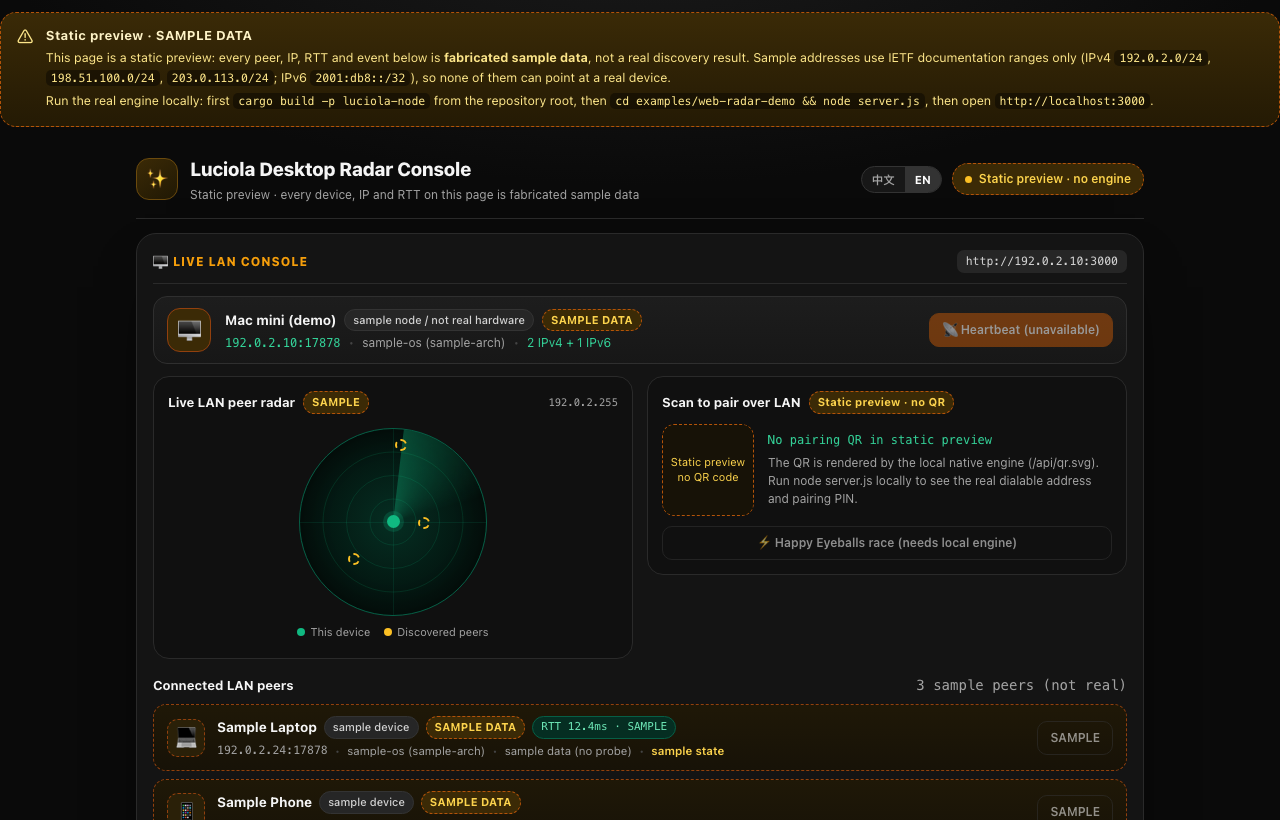
Web radar console (examples/web-radar-demo). This screenshot is the GitHub Pages static preview — sample data, not a real discovery run. Open the demo, or run it locally against the engine to see real peers.
Discover peer devices on a LAN, race the best connection path, and move data over authenticated encrypted channels — on the networks where mDNS dies (Clash/Sing-box TUN modes, IPv6-only China broadband, virtual NICs, routers that drop multicast). One Rust core with first-class Kotlin Multiplatform (Android/JVM/iOS), Swift and Node.js/Electron bindings.
Live demo (static preview, clearly-labelled sample data): https://kexuejin.github.io/luciola/ — GitHub Pages has no engine, so the page never fakes a discovery result.
Run the real thing (the first build compiles the Rust engine — a couple of minutes):
# 1) CLI from crates.io — inspect this machine's LAN in one command
cargo install luciola-cli
luciola-cli ip       # NIC / TUN detection + candidate IPs (--qr prints a terminal QR)
luciola-cli scan     # live peer radar

# 2) Real web radar console (Node 18+; the demo loads the native engine)
git clone https://github.com/kexuejin/luciola.git
cd luciola
cargo build -p luciola-node
cd examples/web-radar-demo
node server.js # then open http://localhost:3000| mDNS / Bonjour | Luciola | |
|---|---|---|
| Multicast dropped (hotel / enterprise Wi-Fi, most consumer routers) | peers disappear | per-NIC subnet-directed broadcast + unicast reconciliation |
Clash / Sing-box TUN hijacks 0.0.0.0/1
|
silently dead |
/24 broadcasts stay outside the intercepted ranges |
| Once a peer is reachable | whatever the app bolts on | authenticated encrypted channel (pre-audit crypto), deny-by-default data plane |
Contents · Features · Why Luciola · Install · CLI · KMP library · Node.js · Demos · Docs · Architecture · Goals · License
0.0.0.0/1 and swallows limited broadcasts; Luciola computes per-NIC subnet-directed broadcasts (192.168.2.255) whose /24 direct routes can't be captured./64 prefix matching treats ISP-assigned GUAs (2408:…, China Telecom/Unicom/Mobile) as same-LAN; dual-stack engine, ff02::1 link-local multicast, IPv6-only discovery.sha256: fingerprints, 6-digit comparison PINs, leveled trust store (Full = silent push, Partial = per-action confirm, unpaired = deny). Discovery is open; data planes are not.
dial() injects link-local scope ids; stop() leaves no zombie accepts.luciola-transfer) — sliding-window chunks with absolute-offset writes (out-of-order safe), contiguous-prefix ACKs, timeout retransmit, 30 s completion cache; 50 MiB E2E over a real secure channel, SHA-256 verified. A luciola-cli transfer send|recv driver now ships with it: dual-stack pin-verified listener, basename-only destination (no path traversal), progress reporting and a verified checksum on completion. Rust core + CLI only — no KMP/Swift/Node surface yet.luciola-tunnel) — TCP/UDP multiplexing with port forwarding (ssh -L/-R equivalents) and UDP session mapping over a SecureStream: a phone browser hits loopback and transparently reaches the desktop's web/NAS/AI services. Per-channel WINDOW flow control (no cross-channel stalls), PING/PONG keepalive, hostname resolve pinning, idle recycling — wire-compatible with v1 peers; deny-by-default ACL, independent supervisor link.bind_failed port-conflict events for same-device multi-product setups, watchdog + debounced network-change rebuilds, Android MulticastLock handling.io.github.kexuejin:luciola, arm64 .so inside the AAR, JVM/iOS variants), Swift bindings + xcframework, Node.js N-API, and a desktop agent that funnels discovery to same-machine products over a unix socket.| Real-world hazard | mDNS / Bonjour | Naive scripts | Luciola |
|---|---|---|---|
| Enterprise / hotel / campus Wi-Fi (multicast dropped) | dead | — | subnet-directed broadcast + unicast reconciliation |
Clash / Sing-box TUN mode (0.0.0.0/1) |
silently dead | ignored | per-NIC /24 broadcasts bypass the capture |
| China broadband IPv6 (GUA-only LAN) | treated as public WAN | IPv4-only |
/64 same-prefix matching + IPv6 discovery/dial |
| WSL2 / Docker / Tailscale virtual NICs | — | picks the wrong IP | NIC scoring + WSL2 host passthrough |
| Router blocks STA→STA multicast | flaky mDNS | — | manualPeers unicast fallback (documented after live testing) |
| Android Doze / app freezer | listeners die | PC-only thinking | watchdog, network-change rebuilds, foreground-service playbook |
| Multiple products on one device | port fights | — |
device_id grouping, per-product ports, desktop agent |
// Gradle — KMP (Android / JVM / iOS). Never add mavenLocal() here:
// a stale local build silently shadows the published artifact (AGENTS.md §3).
repositories { google(); mavenCentral() }
implementation("io.github.kexuejin:luciola:0.11.0") // root coordinate; the android variant resolves to the luciola-android AAR (ships the arm64 .so)
# Rust — crates.io (all seven crates at 0.11.0)
luciola = "0.11.0" # engine, secure channels, trust primitives
luciola-tunnel = "0.11.0" # mux v2 forwarding (the tunnel section below)
# CLI: cargo install luciola-cli@luciola/core is not on npm; build bindings/luciola-node from source (see Node.js).Released 0.11.0 (2026-11-16). The WAN/STUN work is published and registry-verified on crates.io and Maven Central, with the Swift xcframework attached to tag
v0.11.0. The WAN data plane is implemented in the Rust core (luciola::wan::connect_wan: encrypted WSS rendezvous, UDP hole punching with a reliable ordered ARQ, and an opt-in encrypted relay fallback), plus progressive relay→direct migration, RFC 5780 NAT diagnostics, resumable checkpoints, an AIMD congestion window, an optional USB ADB path and native HTTP CONNECT proxy support forwss://signalling (HTTPS_PROXY/NO_PROXY, orWanConfig::proxyin Rust). Those data-plane features are Rust-core + CLI only: the uniffi (KMP/Swift) and Node surfaces exposeconnectWan/WanChannel(establishment, channel type, shutdown) but not the WAN data plane or file transfer. Verified at the unit / loopback layer plus the deployed staging signalling Worker, now reached directly overwss://through the native proxy — not on real NATs, in production, or with mobile background presence. No external audit either. The real-NAT matrix now has an operator runbook, but no paired two-network rows exist yet. A production deployment plan lives in the signalling Worker README. Production went live on 2026-11-14 as deployment0.11.0-wan.1(verified by/health, a signed upgrade and two-peer rendezvous, all single-host and relay-only). See the 0.11.0 section of CHANGELOG.md and the WAN section of SECURITY.md. The published coordinate isio.github.kexuejin:luciola:0.11.0; do not addmavenLocal()to a normal consumer — a stale local build can silently shadow the artifact.
Previous release 0.10.0 (2026-11-05) carried the structured error taxonomy and the transfer CLI. Breaking changes in 0.11.0 (WAN handshake, TOFU-capable
SecureSession.connect, new binding methods): docs/UPGRADING.md.
cargo run -p luciola-cli -- ip      # NIC diagnostics, TUN detection, candidate IPs, QR
cargo run -p luciola-cli -- scan    # live peer radar
cargo run -p luciola-cli -- beacon --name "My Laptop" --qr
cargo run -p luciola-cli -- agent   # per-device discovery daemon (unix-socket event stream)

# Port forwarding (tunnel) — v2 also adds: --remote-forward (-R), --allow-udp,
#   --remote-allow, --udp (UDP session mapping), and hostname targets
cargo run -p luciola-cli -- forward serve --tunnel-port 3001 --seed <hex> --pin-peer <pin> --allow 127.0.0.1:3080
cargo run -p luciola-cli -- forward dial --listen 3080 --connect <peer-ip>:3001 --target 127.0.0.1:3080 --seed <hex> --pin-peer <pin>
cargo run -p luciola-cli -- forward pin --seed <hex>  # derive public key & PIN

# Single-file transfer over a pin-verified secure channel (no TOFU).
# Both peers derive their key with `transfer pin --seed` and pin the OTHER side.
cargo run -p luciola-cli -- transfer recv --port 3020 --seed <hex-b> --accept-pin <pub-a> --out ./received
cargo run -p luciola-cli -- transfer send --file ./photo.zip --connect <peer-ip>:3020 --seed <hex-a> --pin-peer <pub-b>
cargo run -p luciola-cli -- transfer pin --seed <hex> # print public key, fingerprint & PINThe cross-platform entry point is DiscoveryController in commonMain —
peer table, debounced network-change rebuilds, and the watchdog — fed by three
injected ports (DiscoveryEnginePort, NetworkMonitorPort, TaskScheduler).
Each platform ships a thin shell that wires those ports:
| Platform | Shell | Network monitor |
|---|---|---|
| Android | AndroidDiscoveryController |
AndroidNetworkMonitor (ConnectivityManager) |
| Desktop JVM | DesktopDiscoveryController |
DesktopNetworkMonitor (interface polling) |
| iOS (Kotlin) |
DiscoveryController + UniffiEngineAdapter
|
IosNetworkMonitor (Network.framework path monitor) |
| iOS (Swift) | uniffi Swift bindings (DiscoverySession, SecureSession) |
your own NWPathMonitor — what examples/ios-demo runs |
// Android — convenience shell, callbacks marshalled to the main thread
val androidController = AndroidDiscoveryController(
    context = this,
    sessionName = Build.MODEL,
    product = "my-clipboard-app",
    onPeersChanged = { peers -> /* PeerUiModel list, main thread */ },
    onEngineError = { code, msg -> /* surface bind_failed etc. */ },
)
androidController.start()

// Desktop JVM — same supervision core; polls interfaces instead of push events
val desktopController = DesktopDiscoveryController(
    sessionName = System.getenv("USER") ?: "desktop",
    product = "my-app",
    onPeersChanged = { peers -> /* PeerUiModel list, any thread */ },
)
desktopController.start()
// later: desktopController.close()  — stops the engine and the timer thread
iOS, honestly: the Swift path above is what runs in
examples/ios-demo (simulator-verified). The Kotlin path
(IosNetworkMonitor + cinterop bindings + a tunnel loopback e2e) is
runtime-verified on the iOS simulator — cd examples/android-demo && ./gradlew :luciola:iosSimulatorArm64Test
executes inside the simulator: binding smoke over cinterop, the Network.framework
path monitor, tunnel control-plane contracts, and a full tunnel TCP loopback
(bindings/luciola-kmp/src/iosTest/). A physical-device run of the Kotlin path
is still outstanding.
Build the native addon from the repository root first (it is not on npm), then load it:
cargo build -p luciola-nodeconst luciola = require('./bindings/luciola-node'); // built from source (not on npm — see Install)
const ip = luciola.selectLanIp(); // best dialable LAN IP (TUN/WSL/ICS-aware)
const broadcasts = luciola.subnetBroadcastAddresses(); // anti-TUN targets
const session = new luciola.DiscoverySession('My App', 17878, null, 'my-app');
session.start((ev) => { // found | updated | lost | error
if (ev.type === 'found') console.log('peer:', ev.peer.name, ev.peer.ip);
});
// encrypted channel with a paired peer
const id = luciola.generateDeviceIdentity(); // persist the seed securely!
const channel = new luciola.SecureChannel(id.seed);
channel.connect(['192.168.2.82'], 3000, pinnedPeerKey, true, (ev) => {
if (ev.message) console.log('decrypted:', ev.message);
});
// Port forwarding (tunnel) — v2: udp flag, remote forward (-R), UDP mapping, hostname targets
channel.enableForwardEndpoint([{ host: '127.0.0.1', portFrom: 3080, portTo: 3080, udp: false }]); // responder ACL
channel.startLocalForward(3080, '127.0.0.1', 3080); // initiator local bind & transparent tunnelscripts/publish-crates.sh (crates.io), scripts/publish-central.sh (Maven Central), scripts/publish-maven-local.sh (local Maven); native artifacts never enter git.luciola/
├── crates/
│ ├── luciola-ip/ # RFC scopes, /64 GUA matching, 198.18.0.0/15 TUN filter (no_std)
│ ├── luciola-net/ # NIC scoring, WSL2 passthrough, subnet broadcasts, device meta
│ ├── luciola-proto/ # wire protocol: versioned envelopes, jitter/dedup state machine
│ ├── luciola/ # tokio engine: dual-stack discovery, link racing,
│ │ # secure channels, trust & pairing primitives,
│ │ # stun / traversal / wan (channel API on bindings)
│ ├── luciola-transfer/ # chunked file transfer: offset writes, ACK prefix, retransmit
│ ├── luciola-tunnel/ # mux v2: TCP/UDP multiplexing, port forwarding (ssh -L/-R), WINDOW flow control
│ └── luciola-cli/ # ip / scan / beacon / agent / forward / transfer / stun
├── bindings/
│ ├── luciola-kmp/ # Kotlin Multiplatform library (Android AAR + JVM + iOS klib)
│ ├── luciola-swift/ # Swift bindings + xcframework
│ └── luciola-node/ # @luciola/core (N-API)
└── deploy/
└── cloudflare-signaling/ # WSS rendezvous Worker + Durable Object (source; staging deployed separately)
rust lan discovery peer-to-peer p2p kotlin-multiplatform kmp android ios nodejs ipv6 happy-eyeballs local-first zeroconf-alternative mdns-alternative clipboard-sync file-transfer vpn-tun clash
Dual-licensed under MIT or Apache-2.0 — pick either. GPL projects may depend on Luciola safely.
中文文档 · README.zh-CN.md
Web radar console (examples/web-radar-demo). This screenshot is the GitHub Pages static preview — sample data, not a real discovery run. Open the demo, or run it locally against the engine to see real peers.
Discover peer devices on a LAN, race the best connection path, and move data over authenticated encrypted channels — on the networks where mDNS dies (Clash/Sing-box TUN modes, IPv6-only China broadband, virtual NICs, routers that drop multicast). One Rust core with first-class Kotlin Multiplatform (Android/JVM/iOS), Swift and Node.js/Electron bindings.
Live demo (static preview, clearly-labelled sample data): https://kexuejin.github.io/luciola/ — GitHub Pages has no engine, so the page never fakes a discovery result.
Run the real thing (the first build compiles the Rust engine — a couple of minutes):
# 1) CLI from crates.io — inspect this machine's LAN in one command
cargo install luciola-cli
luciola-cli ip       # NIC / TUN detection + candidate IPs (--qr prints a terminal QR)
luciola-cli scan     # live peer radar

# 2) Real web radar console (Node 18+; the demo loads the native engine)
git clone https://github.com/kexuejin/luciola.git
cd luciola
cargo build -p luciola-node
cd examples/web-radar-demo
node server.js # then open http://localhost:3000| mDNS / Bonjour | Luciola | |
|---|---|---|
| Multicast dropped (hotel / enterprise Wi-Fi, most consumer routers) | peers disappear | per-NIC subnet-directed broadcast + unicast reconciliation |
Clash / Sing-box TUN hijacks 0.0.0.0/1
|
silently dead |
/24 broadcasts stay outside the intercepted ranges |
| Once a peer is reachable | whatever the app bolts on | authenticated encrypted channel (pre-audit crypto), deny-by-default data plane |
Contents · Features · Why Luciola · Install · CLI · KMP library · Node.js · Demos · Docs · Architecture · Goals · License
0.0.0.0/1 and swallows limited broadcasts; Luciola computes per-NIC subnet-directed broadcasts (192.168.2.255) whose /24 direct routes can't be captured./64 prefix matching treats ISP-assigned GUAs (2408:…, China Telecom/Unicom/Mobile) as same-LAN; dual-stack engine, ff02::1 link-local multicast, IPv6-only discovery.sha256: fingerprints, 6-digit comparison PINs, leveled trust store (Full = silent push, Partial = per-action confirm, unpaired = deny). Discovery is open; data planes are not.
dial() injects link-local scope ids; stop() leaves no zombie accepts.luciola-transfer) — sliding-window chunks with absolute-offset writes (out-of-order safe), contiguous-prefix ACKs, timeout retransmit, 30 s completion cache; 50 MiB E2E over a real secure channel, SHA-256 verified. A luciola-cli transfer send|recv driver now ships with it: dual-stack pin-verified listener, basename-only destination (no path traversal), progress reporting and a verified checksum on completion. Rust core + CLI only — no KMP/Swift/Node surface yet.luciola-tunnel) — TCP/UDP multiplexing with port forwarding (ssh -L/-R equivalents) and UDP session mapping over a SecureStream: a phone browser hits loopback and transparently reaches the desktop's web/NAS/AI services. Per-channel WINDOW flow control (no cross-channel stalls), PING/PONG keepalive, hostname resolve pinning, idle recycling — wire-compatible with v1 peers; deny-by-default ACL, independent supervisor link.bind_failed port-conflict events for same-device multi-product setups, watchdog + debounced network-change rebuilds, Android MulticastLock handling.io.github.kexuejin:luciola, arm64 .so inside the AAR, JVM/iOS variants), Swift bindings + xcframework, Node.js N-API, and a desktop agent that funnels discovery to same-machine products over a unix socket.| Real-world hazard | mDNS / Bonjour | Naive scripts | Luciola |
|---|---|---|---|
| Enterprise / hotel / campus Wi-Fi (multicast dropped) | dead | — | subnet-directed broadcast + unicast reconciliation |
Clash / Sing-box TUN mode (0.0.0.0/1) |
silently dead | ignored | per-NIC /24 broadcasts bypass the capture |
| China broadband IPv6 (GUA-only LAN) | treated as public WAN | IPv4-only |
/64 same-prefix matching + IPv6 discovery/dial |
| WSL2 / Docker / Tailscale virtual NICs | — | picks the wrong IP | NIC scoring + WSL2 host passthrough |
| Router blocks STA→STA multicast | flaky mDNS | — | manualPeers unicast fallback (documented after live testing) |
| Android Doze / app freezer | listeners die | PC-only thinking | watchdog, network-change rebuilds, foreground-service playbook |
| Multiple products on one device | port fights | — |
device_id grouping, per-product ports, desktop agent |
// Gradle — KMP (Android / JVM / iOS). Never add mavenLocal() here:
// a stale local build silently shadows the published artifact (AGENTS.md §3).
repositories { google(); mavenCentral() }
implementation("io.github.kexuejin:luciola:0.11.0") // root coordinate; the android variant resolves to the luciola-android AAR (ships the arm64 .so)
# Rust — crates.io (all seven crates at 0.11.0)
luciola = "0.11.0" # engine, secure channels, trust primitives
luciola-tunnel = "0.11.0" # mux v2 forwarding (the tunnel section below)
# CLI: cargo install luciola-cli@luciola/core is not on npm; build bindings/luciola-node from source (see Node.js).Released 0.11.0 (2026-11-16). The WAN/STUN work is published and registry-verified on crates.io and Maven Central, with the Swift xcframework attached to tag
v0.11.0. The WAN data plane is implemented in the Rust core (luciola::wan::connect_wan: encrypted WSS rendezvous, UDP hole punching with a reliable ordered ARQ, and an opt-in encrypted relay fallback), plus progressive relay→direct migration, RFC 5780 NAT diagnostics, resumable checkpoints, an AIMD congestion window, an optional USB ADB path and native HTTP CONNECT proxy support forwss://signalling (HTTPS_PROXY/NO_PROXY, orWanConfig::proxyin Rust). Those data-plane features are Rust-core + CLI only: the uniffi (KMP/Swift) and Node surfaces exposeconnectWan/WanChannel(establishment, channel type, shutdown) but not the WAN data plane or file transfer. Verified at the unit / loopback layer plus the deployed staging signalling Worker, now reached directly overwss://through the native proxy — not on real NATs, in production, or with mobile background presence. No external audit either. The real-NAT matrix now has an operator runbook, but no paired two-network rows exist yet. A production deployment plan lives in the signalling Worker README. Production went live on 2026-11-14 as deployment0.11.0-wan.1(verified by/health, a signed upgrade and two-peer rendezvous, all single-host and relay-only). See the 0.11.0 section of CHANGELOG.md and the WAN section of SECURITY.md. The published coordinate isio.github.kexuejin:luciola:0.11.0; do not addmavenLocal()to a normal consumer — a stale local build can silently shadow the artifact.
Previous release 0.10.0 (2026-11-05) carried the structured error taxonomy and the transfer CLI. Breaking changes in 0.11.0 (WAN handshake, TOFU-capable
SecureSession.connect, new binding methods): docs/UPGRADING.md.
cargo run -p luciola-cli -- ip      # NIC diagnostics, TUN detection, candidate IPs, QR
cargo run -p luciola-cli -- scan    # live peer radar
cargo run -p luciola-cli -- beacon --name "My Laptop" --qr
cargo run -p luciola-cli -- agent   # per-device discovery daemon (unix-socket event stream)

# Port forwarding (tunnel) — v2 also adds: --remote-forward (-R), --allow-udp,
#   --remote-allow, --udp (UDP session mapping), and hostname targets
cargo run -p luciola-cli -- forward serve --tunnel-port 3001 --seed <hex> --pin-peer <pin> --allow 127.0.0.1:3080
cargo run -p luciola-cli -- forward dial --listen 3080 --connect <peer-ip>:3001 --target 127.0.0.1:3080 --seed <hex> --pin-peer <pin>
cargo run -p luciola-cli -- forward pin --seed <hex>  # derive public key & PIN

# Single-file transfer over a pin-verified secure channel (no TOFU).
# Both peers derive their key with `transfer pin --seed` and pin the OTHER side.
cargo run -p luciola-cli -- transfer recv --port 3020 --seed <hex-b> --accept-pin <pub-a> --out ./received
cargo run -p luciola-cli -- transfer send --file ./photo.zip --connect <peer-ip>:3020 --seed <hex-a> --pin-peer <pub-b>
cargo run -p luciola-cli -- transfer pin --seed <hex> # print public key, fingerprint & PINThe cross-platform entry point is DiscoveryController in commonMain —
peer table, debounced network-change rebuilds, and the watchdog — fed by three
injected ports (DiscoveryEnginePort, NetworkMonitorPort, TaskScheduler).
Each platform ships a thin shell that wires those ports:
| Platform | Shell | Network monitor |
|---|---|---|
| Android | AndroidDiscoveryController |
AndroidNetworkMonitor (ConnectivityManager) |
| Desktop JVM | DesktopDiscoveryController |
DesktopNetworkMonitor (interface polling) |
| iOS (Kotlin) |
DiscoveryController + UniffiEngineAdapter
|
IosNetworkMonitor (Network.framework path monitor) |
| iOS (Swift) | uniffi Swift bindings (DiscoverySession, SecureSession) |
your own NWPathMonitor — what examples/ios-demo runs |
// Android — convenience shell, callbacks marshalled to the main thread
val androidController = AndroidDiscoveryController(
    context = this,
    sessionName = Build.MODEL,
    product = "my-clipboard-app",
    onPeersChanged = { peers -> /* PeerUiModel list, main thread */ },
    onEngineError = { code, msg -> /* surface bind_failed etc. */ },
)
androidController.start()

// Desktop JVM — same supervision core; polls interfaces instead of push events
val desktopController = DesktopDiscoveryController(
    sessionName = System.getenv("USER") ?: "desktop",
    product = "my-app",
    onPeersChanged = { peers -> /* PeerUiModel list, any thread */ },
)
desktopController.start()
// later: desktopController.close()  — stops the engine and the timer thread
iOS, honestly: the Swift path above is what runs in
examples/ios-demo (simulator-verified). The Kotlin path
(IosNetworkMonitor + cinterop bindings + a tunnel loopback e2e) is
runtime-verified on the iOS simulator — cd examples/android-demo && ./gradlew :luciola:iosSimulatorArm64Test
executes inside the simulator: binding smoke over cinterop, the Network.framework
path monitor, tunnel control-plane contracts, and a full tunnel TCP loopback
(bindings/luciola-kmp/src/iosTest/). A physical-device run of the Kotlin path
is still outstanding.
Build the native addon from the repository root first (it is not on npm), then load it:
cargo build -p luciola-nodeconst luciola = require('./bindings/luciola-node'); // built from source (not on npm — see Install)
const ip = luciola.selectLanIp(); // best dialable LAN IP (TUN/WSL/ICS-aware)
const broadcasts = luciola.subnetBroadcastAddresses(); // anti-TUN targets
const session = new luciola.DiscoverySession('My App', 17878, null, 'my-app');
session.start((ev) => { // found | updated | lost | error
if (ev.type === 'found') console.log('peer:', ev.peer.name, ev.peer.ip);
});
// encrypted channel with a paired peer
const id = luciola.generateDeviceIdentity(); // persist the seed securely!
const channel = new luciola.SecureChannel(id.seed);
channel.connect(['192.168.2.82'], 3000, pinnedPeerKey, true, (ev) => {
if (ev.message) console.log('decrypted:', ev.message);
});
// Port forwarding (tunnel) — v2: udp flag, remote forward (-R), UDP mapping, hostname targets
channel.enableForwardEndpoint([{ host: '127.0.0.1', portFrom: 3080, portTo: 3080, udp: false }]); // responder ACL
channel.startLocalForward(3080, '127.0.0.1', 3080); // initiator local bind & transparent tunnelscripts/publish-crates.sh (crates.io), scripts/publish-central.sh (Maven Central), scripts/publish-maven-local.sh (local Maven); native artifacts never enter git.luciola/
├── crates/
│ ├── luciola-ip/ # RFC scopes, /64 GUA matching, 198.18.0.0/15 TUN filter (no_std)
│ ├── luciola-net/ # NIC scoring, WSL2 passthrough, subnet broadcasts, device meta
│ ├── luciola-proto/ # wire protocol: versioned envelopes, jitter/dedup state machine
│ ├── luciola/ # tokio engine: dual-stack discovery, link racing,
│ │ # secure channels, trust & pairing primitives,
│ │ # stun / traversal / wan (channel API on bindings)
│ ├── luciola-transfer/ # chunked file transfer: offset writes, ACK prefix, retransmit
│ ├── luciola-tunnel/ # mux v2: TCP/UDP multiplexing, port forwarding (ssh -L/-R), WINDOW flow control
│ └── luciola-cli/ # ip / scan / beacon / agent / forward / transfer / stun
├── bindings/
│ ├── luciola-kmp/ # Kotlin Multiplatform library (Android AAR + JVM + iOS klib)
│ ├── luciola-swift/ # Swift bindings + xcframework
│ └── luciola-node/ # @luciola/core (N-API)
└── deploy/
└── cloudflare-signaling/ # WSS rendezvous Worker + Durable Object (source; staging deployed separately)
rust lan discovery peer-to-peer p2p kotlin-multiplatform kmp android ios nodejs ipv6 happy-eyeballs local-first zeroconf-alternative mdns-alternative clipboard-sync file-transfer vpn-tun clash
Dual-licensed under MIT or Apache-2.0 — pick either. GPL projects may depend on Luciola safely.
中文文档 · README.zh-CN.md
