Implements a system ensuring social distancing in a lab using wearables and a monitor. Utilizes a pulverization approach for dynamic component distribution based on server load.
Many people may have access to a laboratory and for security reasons they must maintain a certain distance on average. The laboratory can sense the distance between people through a wearable that they wear. To ensure the distance between people within the laboratory, a green color is shown on a monitor when people are far apart, and a red color the closer people are to each other.
A possible implementation of this scenario may involve the definition of the following devices: wearable and laboratory. The former has the task of sensing other wearables by determining their distances, then sending that information to the laboratory. The latter has the task of determining a laboratory congestion metric based on the average of the distances (received from the wearables) and transforming this metric into the corresponding color that will be shown on the screen.
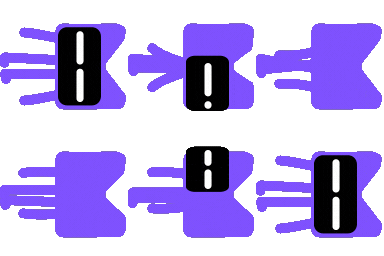
The proposed demo exploits the pulverization approach to implement the above system via the pulverization-framework. Specifically, the two devices, wearable and laboratory, are structured as follows:
The wearable through the Sensor component senses the other devices through the RSSI value of Bluetooth (simulated). Through the Behavior, it converts the RSSI values to distances and then sends this data to the laboratory through the Communication component.
Similarly, the laboratory receives the distance data from the various wearables through the Communication component, determines the average distance of the devices in the room and persists this information in the State component, and then converts the average distance into the respective color which is then shown on the screen through the Actuator component.
The infrastructure provided to run this system includes the following hosts:
Initially the wearables start with Behavior component running on the server, while the other components are run on the Smartphone. The laboratory device has all components running on the PC. A reconfiguration rule is defined such that when the server has a high load, the wearables' Behavior component is moved from the Server to the Smartphone.
Run the demo with:
$ docker-compose upAfter the startup of the docker-compose, the following logs represents the framework initialization:
...
pc           | Info: (Behaviour[component]Communicator) Setup communicator
pc           | Info: (RabbitmqCommunicator) Setup RabbitMQ communicator from Behaviour[component] and Communication[component]
pc           | Info: (Behaviour[component]Communicator) Setup communicator
pc           | Info: (RabbitmqCommunicator) Setup RabbitMQ communicator from Behaviour[component] and Actuators[component]
server       | Info: (Behaviour[component]Communicator) Setup communicator
server       | Info: (RabbitmqCommunicator) Setup RabbitMQ communicator from Behaviour[component] and Sensor[component]
pc           | Info: (Sensor[component]Communicator) Setup communicator
pc           | Info: (RabbitmqCommunicator) Setup RabbitMQ communicator from Sensor[component] and Behaviour[component]
server       | Info: (Communication[component]Communicator) Setup communicator
server       | Info: (RabbitmqCommunicator) Setup RabbitMQ communicator from Communication[component] and Behaviour[component]
smartphones  | Info: (Behaviour[component]Communicator) Setup communicator
smartphones  | Info: (RabbitmqCommunicator) Setup RabbitMQ communicator from Behaviour[component] and Sensor[component]
server       | Info: (State[component]Communicator) Setup communicator
pc           | Info: (Actuators[component]Communicator) Setup communicator
pc           | Info: (RabbitmqCommunicator) Setup RabbitMQ communicator from Actuators[component] and Behaviour[component]
server       | Info: (RabbitmqCommunicator) Setup RabbitMQ communicator from State[component] and Behaviour[component]
...
After the initialization step, each deployment unit starts to run the components. In particular, each smartphone starts sending to the laboratory the distances from the other smartphones. The following log example shows this interaction:
...
smartphones  | Info: (WearableSensors) Wearable#1 Perceived neighbours: {2=-56, 3=-56}
server       | Info: (WearableBehaviour) Wearable#1 distances: {2=0.6309573444801932, 3=0.6309573444801932}
pc           | Info: (LaboratoryBehaviour) Mean distance: 1.620525177448518
pc           | Info: (LaboratoryActuator) Print color: ██████████
smartphones  | Info: (WearableSensors) Wearable#3 Perceived neighbours: {1=-63, 2=-57}
server       | Info: (WearableBehaviour) Wearable#3 distances: {1=1.4125375446227544, 2=0.7079457843841379}
pc           | Info: (LaboratoryBehaviour) Mean distance: 1.6333565840991753
pc           | Info: (LaboratoryActuator) Print color: ██████████
smartphones  | Info: (WearableSensors) Wearable#2 Perceived neighbours: {1=-66, 3=-74}
server       | Info: (WearableBehaviour) Wearable#2 distances: {1=1.9952623149688795, 3=5.011872336272722}
pc           | Info: (LaboratoryBehaviour) Mean distance: 1.7315887782014798
pc           | Info: (LaboratoryActuator) Print color: ██████████
...
The order of the printed log does not represent the real order on which the communication occurs.
Nevertheless, from the log above:
Info: (WearableSensors) Wearable#<n> Perceived neighbours: {<n_1>=-<rssi>, <n_2>=-<rssi>}
represents that the device <n> has perceived the <n_1> and <n_2> smartphones with their corresponding RSSI.
Info: (WearableBehaviour) Wearable#<n> distances: {<n_1>=<distance>, <n_2>=<distance>} represents the conversion
of each sensed RSSI into the corresponding distance.
Info: (LaboratoryBehaviour) Mean distance: <mean_distance> means that the laboratory has updated its congestion metrics.
Info: (LaboratoryActuator) Print color: [COLOR] represents the color update in the monitor relative to the metrics update.
The reconfiguration event can be observed when the following prints are reported in the log:
...
server       | New reconfiguration!
server       | New reconfiguration!
server       | New reconfiguration!
...
Once the reconfiguration is finished the log changes accordingly:
...
smartphones  | Info: (WearableSensors) Wearable#2 Perceived neighbours: {1=-68, 3=-69}
smartphones  | Info: (WearableBehaviour) Wearable#2 distances: {1=2.51188643150958, 3=2.8183829312644537}
pc           | Info: (LaboratoryBehaviour) Mean distance: 1.8090095008099896
pc           | Info: (LaboratoryActuator) Print color: ██████████
smartphones  | Info: (WearableSensors) Wearable#1 Perceived neighbours: {2=-60, 3=-75}
smartphones  | Info: (WearableBehaviour) Wearable#1 distances: {2=1.0, 3=5.623413251903491}
pc           | Info: (LaboratoryBehaviour) Mean distance: 2.516087731777883
pc           | Info: (LaboratoryActuator) Print color: ██████████
smartphones  | Info: (WearableSensors) Wearable#3 Perceived neighbours: {1=-62, 2=-73}
smartphones  | Info: (WearableBehaviour) Wearable#3 distances: {1=1.2589254117941673, 2=4.466835921509632}
pc           | Info: (LaboratoryBehaviour) Mean distance: 2.9465739913302205
pc           | Info: (LaboratoryActuator) Print color: ██████████
...
As can be seen, the Behaviour moves from the Server into the Smartphones.
This can be seen because the log is printed from the smartphones container (previously executed on server one).
To have a more verbose log, the DEBUG_LOG_LEVEL environment variable can be set to 1.
This enables the debug log inside the framework to show the interaction and communication between components to
better understand how the framework behaves.
Many people may have access to a laboratory and for security reasons they must maintain a certain distance on average. The laboratory can sense the distance between people through a wearable that they wear. To ensure the distance between people within the laboratory, a green color is shown on a monitor when people are far apart, and a red color the closer people are to each other.
A possible implementation of this scenario may involve the definition of the following devices: wearable and laboratory. The former has the task of sensing other wearables by determining their distances, then sending that information to the laboratory. The latter has the task of determining a laboratory congestion metric based on the average of the distances (received from the wearables) and transforming this metric into the corresponding color that will be shown on the screen.
The proposed demo exploits the pulverization approach to implement the above system via the pulverization-framework. Specifically, the two devices, wearable and laboratory, are structured as follows:
The wearable through the Sensor component senses the other devices through the RSSI value of Bluetooth (simulated). Through the Behavior, it converts the RSSI values to distances and then sends this data to the laboratory through the Communication component.
Similarly, the laboratory receives the distance data from the various wearables through the Communication component, determines the average distance of the devices in the room and persists this information in the State component, and then converts the average distance into the respective color which is then shown on the screen through the Actuator component.
The infrastructure provided to run this system includes the following hosts:
Initially the wearables start with Behavior component running on the server, while the other components are run on the Smartphone. The laboratory device has all components running on the PC. A reconfiguration rule is defined such that when the server has a high load, the wearables' Behavior component is moved from the Server to the Smartphone.
Run the demo with:
$ docker-compose upAfter the startup of the docker-compose, the following logs represents the framework initialization:
...
pc           | Info: (Behaviour[component]Communicator) Setup communicator
pc           | Info: (RabbitmqCommunicator) Setup RabbitMQ communicator from Behaviour[component] and Communication[component]
pc           | Info: (Behaviour[component]Communicator) Setup communicator
pc           | Info: (RabbitmqCommunicator) Setup RabbitMQ communicator from Behaviour[component] and Actuators[component]
server       | Info: (Behaviour[component]Communicator) Setup communicator
server       | Info: (RabbitmqCommunicator) Setup RabbitMQ communicator from Behaviour[component] and Sensor[component]
pc           | Info: (Sensor[component]Communicator) Setup communicator
pc           | Info: (RabbitmqCommunicator) Setup RabbitMQ communicator from Sensor[component] and Behaviour[component]
server       | Info: (Communication[component]Communicator) Setup communicator
server       | Info: (RabbitmqCommunicator) Setup RabbitMQ communicator from Communication[component] and Behaviour[component]
smartphones  | Info: (Behaviour[component]Communicator) Setup communicator
smartphones  | Info: (RabbitmqCommunicator) Setup RabbitMQ communicator from Behaviour[component] and Sensor[component]
server       | Info: (State[component]Communicator) Setup communicator
pc           | Info: (Actuators[component]Communicator) Setup communicator
pc           | Info: (RabbitmqCommunicator) Setup RabbitMQ communicator from Actuators[component] and Behaviour[component]
server       | Info: (RabbitmqCommunicator) Setup RabbitMQ communicator from State[component] and Behaviour[component]
...
After the initialization step, each deployment unit starts to run the components. In particular, each smartphone starts sending to the laboratory the distances from the other smartphones. The following log example shows this interaction:
...
smartphones  | Info: (WearableSensors) Wearable#1 Perceived neighbours: {2=-56, 3=-56}
server       | Info: (WearableBehaviour) Wearable#1 distances: {2=0.6309573444801932, 3=0.6309573444801932}
pc           | Info: (LaboratoryBehaviour) Mean distance: 1.620525177448518
pc           | Info: (LaboratoryActuator) Print color: ██████████
smartphones  | Info: (WearableSensors) Wearable#3 Perceived neighbours: {1=-63, 2=-57}
server       | Info: (WearableBehaviour) Wearable#3 distances: {1=1.4125375446227544, 2=0.7079457843841379}
pc           | Info: (LaboratoryBehaviour) Mean distance: 1.6333565840991753
pc           | Info: (LaboratoryActuator) Print color: ██████████
smartphones  | Info: (WearableSensors) Wearable#2 Perceived neighbours: {1=-66, 3=-74}
server       | Info: (WearableBehaviour) Wearable#2 distances: {1=1.9952623149688795, 3=5.011872336272722}
pc           | Info: (LaboratoryBehaviour) Mean distance: 1.7315887782014798
pc           | Info: (LaboratoryActuator) Print color: ██████████
...
The order of the printed log does not represent the real order on which the communication occurs.
Nevertheless, from the log above:
Info: (WearableSensors) Wearable#<n> Perceived neighbours: {<n_1>=-<rssi>, <n_2>=-<rssi>}
represents that the device <n> has perceived the <n_1> and <n_2> smartphones with their corresponding RSSI.
Info: (WearableBehaviour) Wearable#<n> distances: {<n_1>=<distance>, <n_2>=<distance>} represents the conversion
of each sensed RSSI into the corresponding distance.
Info: (LaboratoryBehaviour) Mean distance: <mean_distance> means that the laboratory has updated its congestion metrics.
Info: (LaboratoryActuator) Print color: [COLOR] represents the color update in the monitor relative to the metrics update.
The reconfiguration event can be observed when the following prints are reported in the log:
...
server       | New reconfiguration!
server       | New reconfiguration!
server       | New reconfiguration!
...
Once the reconfiguration is finished the log changes accordingly:
...
smartphones  | Info: (WearableSensors) Wearable#2 Perceived neighbours: {1=-68, 3=-69}
smartphones  | Info: (WearableBehaviour) Wearable#2 distances: {1=2.51188643150958, 3=2.8183829312644537}
pc           | Info: (LaboratoryBehaviour) Mean distance: 1.8090095008099896
pc           | Info: (LaboratoryActuator) Print color: ██████████
smartphones  | Info: (WearableSensors) Wearable#1 Perceived neighbours: {2=-60, 3=-75}
smartphones  | Info: (WearableBehaviour) Wearable#1 distances: {2=1.0, 3=5.623413251903491}
pc           | Info: (LaboratoryBehaviour) Mean distance: 2.516087731777883
pc           | Info: (LaboratoryActuator) Print color: ██████████
smartphones  | Info: (WearableSensors) Wearable#3 Perceived neighbours: {1=-62, 2=-73}
smartphones  | Info: (WearableBehaviour) Wearable#3 distances: {1=1.2589254117941673, 2=4.466835921509632}
pc           | Info: (LaboratoryBehaviour) Mean distance: 2.9465739913302205
pc           | Info: (LaboratoryActuator) Print color: ██████████
...
As can be seen, the Behaviour moves from the Server into the Smartphones.
This can be seen because the log is printed from the smartphones container (previously executed on server one).
To have a more verbose log, the DEBUG_LOG_LEVEL environment variable can be set to 1.
This enables the debug log inside the framework to show the interaction and communication between components to
better understand how the framework behaves.